


Behavior Support Program
Original price was: € 179,80.€ 0,00Current price is: € 0,00.
Chronic stress and anxiety in dogs and cats are not just a behavioral problem but a physical condition that affects the entire system. This protocol combines four supplements that calm the nervous system, lower cortisol, and support bowel function: medicinal mushrooms, ashwagandha and rhodiola, CBD oil, and Relax Support.
Suitable for: separation anxiety, noise phobia, aggression, overstimulation, compulsive licking or biting, and stress in cats. In case of chronic complaints, advice to combine with the Bowel Protocol.
- Modulates the HPA axis and cortisol dysregulation via adaptogens
- Works for structural anxiety problems and for situation-related stress such as fireworks, vet or travel
- Supports neurotransmitter balance via the gut-brain axis
- Reduces overstimulation and acute stress reactivity without sedation
- Suitable as a supplement to behavioural therapy and training programmes
Description
QUICK SUMMARY
The NGD Care Behavior Support Program helps with: anxiety, aggression, overstimulation, separation anxiety and chronic stress in dogs and cats. Behavioral problems often have a physical cause: an overactive nervous system, a disturbed gut-brain axis or a shortage of neurotransmitter precursors. This process tackles that cause, starting with the intestine.
Why a program and not just behavioral training?
Behavioural training is valuable, but has limited effect if the animal’s nervous system cannot calm itself down due to a biochemical deficiency or imbalance. Serotonin, GABA, dopamine and cortisol are the neurochemical building blocks of behaviour. If these are out of balance due to deficiencies in precursors, an overactive HPA axis or a disturbed microbiome, the animal is physiologically unable to learn to relax.
The gut-brain axis is a key concept here: 90% of the serotonin in the body is produced in the gut. An imbalance in the microbiome produces fewer serotonin precursors and more pro-inflammatory substances that affect brain function. As a result, many behavioural problems in dogs and cats have an intestinal component that is rarely included in the standard behavioural approach. That is why the NGD Care Behavior Support Program starts at the intestine, not at the nervous system.
The Behavior Support Program supports gut health, nervous system and stress hormone balance, in that order. Combined with behavioral training, this gives the best results.
How does the Behavior Support Program work?
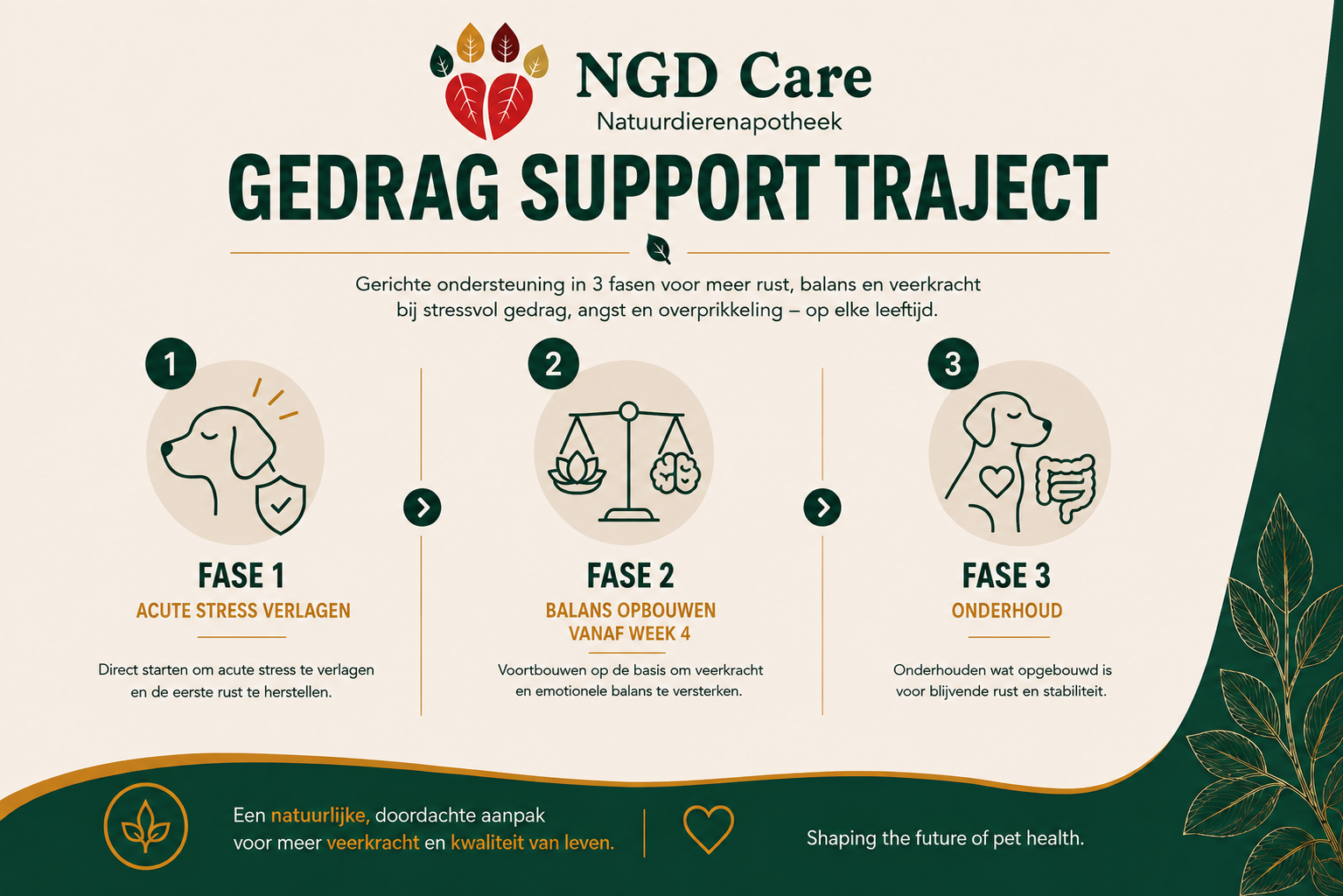
The process starts with intestinal recovery as a foundation, and then builds up in three phases. Phase 1 reduces acute stress. Phase 2 builds up a sustainable balance from week 4 onwards. Phase 3 is the maintenance phase once the animal is stable.
We recommend starting the Bowel Recovery Process, before or simultaneously with phase 1. 90% of the serotonin in the body is produced in the gut, and chronic stress disrupts the microbiome that produces serotonin precursors and other neurotransmitter building blocks via the gut-brain axis. Without this foundation, the effect of phases 1 to 3 is less sustainable.
Phase 1 starts with three supplements at the same time. Relax Support provides L-theanine for direct alpha brainwave modulation, L-tryptophan as a serotonin precursor, and magnesium as a nervous system cofactor. CBD oil modulates the endocannabinoid system for anxiety and pain regulation. Adaptogen Complex supports the HPA axis from the start via ashwagandha (cortisol modulation and GABA activation) and rhodiola (energy recovery and resilience), so that the stress response is not only dampened but also gradually adjusted. Effect of Relax Support and CBD oil is usually noticeable within days; Adaptogen Complex takes two to four weeks for full effect.
After four weeks, you build on phase 1: CBD oil, Relax Support and Adaptogen Complex are continued, supplemented with Myco Adaptogen Complex and Liposomal Vitamin B Complex. Myco Adaptogen Complex provides Reishi for calming via histamine inhibition and Lion’s Mane for NGF stimulation, which supports longer-term nerve recovery. Vitamin B-Complex supplements the B vitamins that the nervous system uses extra in chronic stress and acts as a cofactor for neurotransmitter production. This phase converts the short-term calming of phase 1 into a more sustainable stress resistance.
Once the acute stress response has stabilized, you reduce to the maintenance phase: Prebiotics, Adaptogen Complex and Myco Adaptogen Complex. Prebiotics support the gut-brain axis and the bacteria that produce serotonin, dopamine, and GABA precursors. Adaptogen Complex and Myco Adaptogen Complex keep the HPA axis balance and nervous system stable in the long term, without the direct calming support of CBD oil and Relax Support, which are especially relevant in the acute and build-up phases.
When do you see results?
Behavioural change takes time. From a systems biology point of view, the HPA axis recovers more slowly than neurotransmitters respond, and the gut recovers even more gradually. Expect a first wave of effect through phase 1, followed by deeper stabilization through phase 2 and intestinal repair.
Phase 1 started. L-theanine and CBD are active. First signs of more rest and less overreaction to stress stimuli.
Adaptogen Complex from phase 1 becomes effective. Calmer basic level, better sleep, less overstimulation. Increased learning capacity for behavioral training.
Phase 2 started. HPA axis further balanced. Significantly calmer behavior, less anxious reactions, better interaction with environment and owner.
Structurally more balanced animal, intestine also recovered. Transition to phase 3 (maintenance) possible in consultation, based on results.
Don’t see any improvement after six weeks? Schedule an intake with integrative veterinarian Stefan Veenstra. Severe fear or aggression always requires a combined approach with a behavioural therapist.
Frequently Asked Questions (FAQ)
Can I combine this process with medication for anxiety or aggression from the vet?
Yes, in many cases this process can be used as a supplement to regular medication. Always discuss this with the prescribing veterinarian, especially when combining it with sedative medication or antidepressants.
Do I have to start the Bowel Recovery Trajectory and phase 1 at the same time?
We advise that, yes. Start the Bowel Recovery Journey before or simultaneously with phase 1 (CBD oil, Relax Support, Adaptogen Complex). After four weeks, phase 2 follows automatically with two additional supplements. Phase 3 (maintenance) only starts as soon as the acute stress is under control.
Does this process also work for fireworks or noise anxiety that only occurs occasionally?
In case of occasional anxiety, such as around New Year’s Eve, phase 1 (CBD oil and Relax Support) is especially relevant and you can start it shortly in advance. In the case of chronic anxiety or stress, the entire process, including intestinal recovery, is necessary for a sustainable result. Our fireworks support program is better suited for this.
Is this program also suitable for cats?
Yes, anxiety, overstimulation, and stress-related behaviors also occur in cats, and the underlying neurochemical and gut-brain-axis mechanisms are similar. Dosages and product choice are adapted to the cat.
Why the NGD Care Behavior Support Program?
| Characteristic | NGD Care Behavior Support Program | Standard approach |
|---|---|---|
| Approach | Bowel recovery as a start, followed by neurotransmitters and HPA axis in three phases | Behavioral training or medication separately |
| Side effects | ✅ Minimal, no sedation or addiction | Pharmaceutical tranquilizers: sedation and side effects |
| Gut-brain axis | ✅ Starting point of the process, not a separate addition | ❌ Rarely included in behavioural approach |
| Scientifically substantiated | ✅ Yes ashwagandha RCT dogs 2024, CBD osteoarthritis RCT | Variable |
| Developed by veterinarian | ✅ Stefan Veenstra DVM | Rarely |
| Personal guidance | ✅ Intake possible via Naturally Healthy Animals | ❌ Not available |
Is this program suitable for my animal?
In case of serious aggression, always call in a certified behavioural therapist. This program is an addition to, not a replacement for, behavioral therapy.
Want to read the full scientific background?
Stefan Veenstra DVM explains how the gut-brain axis works and why gut and neurochemical balance is the basis for behavioral change.
Supplements in this process
Developed and clinically substantiated by Stefan Veenstra DVM, integrative veterinarian. Stefan is the founder of NGD Care, NGD Care Academy and Integrative Veterinary Center Natural Healthy Animals. Read more about Stefan →
This program is educational in nature and does not replace a veterinary consultation. In case of serious aggression, always call in a certified behavioural therapist.
Ingredients, dosage and use
- See the individual ingredients
- For the first month, we recommend a double therapeutic dose of 2x daily. Then a maintenance dose of 1x daily.
- Each phase is suitable for a treatment of 2-4 months for a dog or cat <10kg and for 1-2 months for a dog of 10-30kg.
Disclaimer
- This product is a dietary supplement and not a substitute for a healthy lifestyle and varied balanced diet.
- The products are not medicines and cannot be used as medicines, but as a dietary supplement. In case of illness or other medical condition, always consult a veterinarian before use.
- Dietary supplements may have interactions and side effects with regular medications.
- Keep out of reach of young children.
- Consult an expert before using supplements in case of pregnancy, lactation, medication use and illness.
You may also like…
-
Stress support
From € 21,95 Select options This product has multiple variants. The options may be chosen on the product page -
Bowel Recovery Trajectory
€ 0,00 Select options

Reviews
There are no reviews yet.