


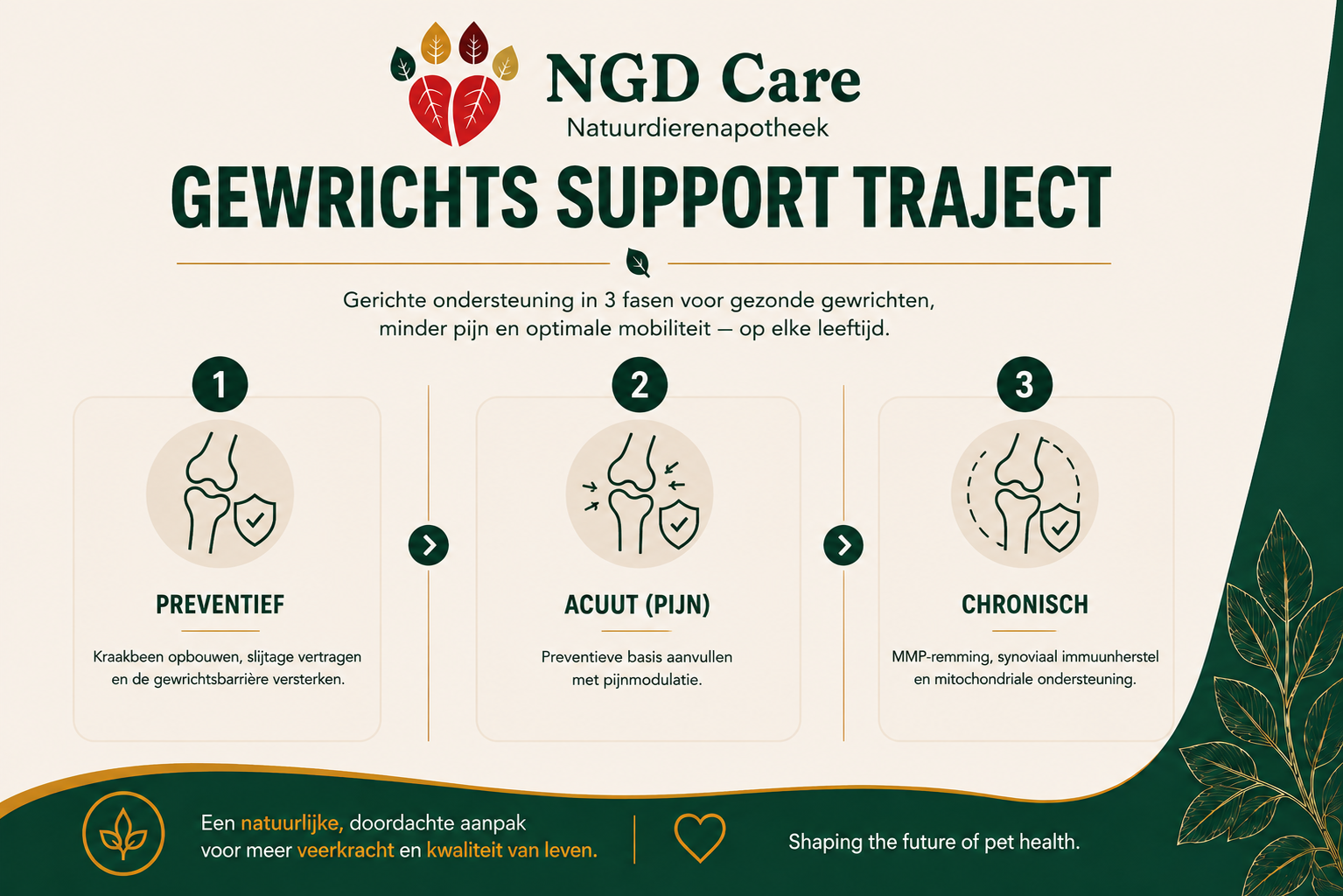
Joint Support Trajectory
€ 84,90
Dogs and cats with stiff stand-up, osteoarthritis, or joint wear often benefit from more than just pain relief, as the underlying cartilage breakdown and chronic inflammation go untreated. The NGD Care Joint Support Pathway combines preventive cartilage support, pain modulation and, in chronic osteoarthritis, direct inhibition of the MMP enzymes that break down cartilage.
Suitable for: osteoarthritis, joint wear, dysplasia in large breeds, stiffness after rest, chronic joint pain and preventive use in large or active dogs from two years of age.
- Preventive basis with Mobility Support delivers collagen type II and hyaluronic acid from eggshell membrane
- PEA Complex modulates pain via PPAR-alpha activation, without the side effects of long-term NSAID use
- Liposomal Curcumin inhibits MMP-13, the enzyme that structurally breaks down cartilage
- Myco Immune Complex directs synovial macrophages to an anti-inflammatory phenotype
- Can also be used preventively for large breeds and dysplasia predisposition from the age of two
Description
The NGD Care Joint Support Program supports dogs and cats with stiff standing up, difficulty climbing stairs, joint pain, osteoarthritis and joint wear. The process addresses both the pain and the underlying cause: the chronic inflammation that breaks down cartilage. Can also be used preventively in large breeds and active dogs.
Why a program and not a single joint supplement?
Joint pain in dogs and cats has two components that both need to be addressed: the inflammation that damages the joint, and the loss of cartilage that results from that inflammation. A supplement that only inhibits pain does not address the cause. A supplement that only provides nutrients has limited effect if the inflammation breaks down the cartilage faster than it can be built up.
Osteoarthritis is a systemic disease of the joint in which several processes are disrupted at the same time: MMP enzymes break down collagen, pro-inflammatory cytokines maintain inflammation, activated synovial macrophages feed the cytokine cascade and mitochondria in chondrocytes become exhausted. A single supplement can only address one of these processes.
The NGD Care Joint Support Trajectory is therefore divided into four layers that build on each other: bowel repair as a systemic inflammatory basis in chronic osteoarthritis, preventive for those who want to prevent wear and tear, supplemented with pain modulation in pain, and extended to the full systemic trajectory in chronic osteoarthritis.
How does the Joint Support Program work?
In chronic osteoarthritis, we recommend starting with the Bowel Recovery Trajectory, as a supplement to the systemic inflammatory pressure. The three layers thereafter build on each other: the preventive foundation lays the cartilage foundations and inhibits low-grade wear, pain modulation is added in case of pain, and in chronic osteoarthritis, the pathway is expanded to include direct MMP inhibition, synovial immune repair, and mitochondrial support of chondrocytes.
In the case of chronic osteoarthritis, we recommend starting the Bowel Recovery Process in addition to this process. Chronic low-grade inflammation is partly driven by endotoxins (LPS) that reach the bloodstream with increased intestinal permeability and activate the synovial macrophages via TLR4 and NF-kB. In the case of persistent osteoarthritis despite the chronic layer, intestinal repair is therefore a useful addition to the systemic inflammatory pressure.
Mobility Support provides the complete cartilage matrix via eggshell membrane: collagen type II, hyaluronic acid and the growth factors IGF-1 and TGF-beta. This is the structural basis, also preventive, because cartilage does not have its own blood vessels and can only be built up if the building materials are structurally available. O-Mega Blend provides calanus oil, a sustainably sourced omega-3 source that inhibits the COX pathway that drives MMP activation in cartilage via EPA, DHA, and stearidonic acid, and maintains the quality of the synovial fluid. Histamine Balance combines MSM and quercetin: MSM provides bioavailable sulfur as a building material for the cartilage matrix, quercetin inhibits low-grade joint inflammation via NF-kB that accelerates wear and tear. Recommended for large breeds from two years of age, for active dogs and dogs with dysplasia predisposition.
In case of visible pain, stiffness or reluctant movement, the preventive layer is expanded with PEA Complex. PEA modulates pain via PPAR-alpha activation and inhibits mast cell activation in joint tissue without the side effects of long-term NSAID use. Effect noticeable within one to two weeks. PEA works synergistically with the omega-3 in O-Mega Blend: both inhibit the prostaglandin cascade on complementary pathways. For pain with a strong central or stress-related component, supplemental CBD oil is an option.
In the case of chronic osteoarthritis, the entire process is started with three additions, each of which addresses a different level of the cascade. Liposomal Curcumin inhibits NF-kB and directly MMP-13, the enzyme that breaks down collagen type II. This makes curcumin mechanistically more relevant than CBD in osteoarthritis: curcumin inhibits structural cartilage breakdown, CBD mainly modulates pain perception. Myco Immune Complex modulates the synovial macrophages that maintain the cytokine cascade via beta-glucans. Activated M1 macrophages in the synovial fluid are the central driver of chronic joint inflammation; beta-glucans direct macrophage polarization towards the anti-inflammatory M2 phenotype and inhibit NF-kB and MAPK at the synovial level. Liposomal Coenzyme Q10 restores mitochondrial energy production in chondrocytes: without sufficient ATP, chondrocytes cannot convert the building blocks of Mobility Support into cartilage repair. In long-term chronic use, supplemental Shilajit is an option: a human RCT (2024) showed stimulation of type 1 collagen synthesis; fulvic acid synergistically supports mitochondrial biogenesis with CoQ10. Veterinary RCT data in dogs are still lacking.
When do you see results?
Joint repair occurs via two time scales. Pain modulation responds quickly via PEA and omega-3. Cartilage build-up is a slow biological process because cartilage does not have its own blood vessels. Give the entire process at least three months for an honest assessment of the structural effect.
PEA modulates pain. Fewer pain reactions when moving. Easier to get up. More willingness to be active.
Clearly less stiffness after halftime. Move more smoothly. Less restraint when climbing stairs and jumping.
Structural cartilage repair via Mobility Support and CoQ10. Better synovial fluid quality. More desire to play and vitality.
Daily maintenance inhibits further wear. In osteoarthritis, this is a long-term process. Possible reduction of NSAIDs in consultation with veterinarian.
Don’t see any improvement after six weeks? Schedule an intake with Stefan Veenstra. Never adjust the process without consulting a veterinarian if your animal is also taking NSAIDs.
Why the NGD Care Joint Support Program?
| Characteristic | NGD Care Joint Support Trajectory | Standard approach |
|---|---|---|
| Inflammatory pathways | ✅ COX, NF-kB, PPAR-alpha, MMP-13 and synovial macrophage level | NSAID: COX inhibition only |
| Cartilage repair | ✅ Complete matrix of growth factors via eggshell membrane | NSAID: no cartilage buildup |
| used preventively | ✅ Yes, from 2 years of age in large breeds and dysplasia predisposition | Only in case of complaints |
| Long-term | ✅ Minimal, no stomach or kidney strain | NSAIDs: gastric, liver and kidney burden with chronic use |
| Scientifically substantiated | ✅ RCT 2025 eggshell membrane, PEA RCT dogs, omega-3 osteoarthritis | Yes for NSAIDs |
| Developed by veterinarian | ✅ Stefan Veenstra DVM | Rare for supplement trajectory |
| Personal guidance | ✅ Intake possible via Naturally Healthy Animals | ❌ Not available |
Is this program suitable for my animal?
Never adjust this trajectory if your animal is also taking NSAIDs or corticosteroids without consulting a veterinarian. Combinations can influence each other’s effect.
Frequently asked questions
Is the Joint Support Trajectory safe to combine with NSAIDs or corticosteroids?
Yes, the supplements in this pathway work through different routes than NSAIDs and are usually easy to combine. Always consult with your veterinarian before adjusting or tapering off existing medication.
When will I notice improvement in my dog or cat?
Pain modulation via PEA Complex is often noticeable within one to two weeks. Structural cartilage repair is slower; Count on at least three months for an honest picture of the effect.
Is this program also suitable if my dog or cat does not yet have any complaints?
Yes. The preventive layer, Mobility Support, O-Mega Blend and Histamine Balance, is suitable from the age of two in large breeds, dysplasia predisposition or in active and sporty dogs, even without visible complaints.
Can I only use the preventive supplements, or do I have to follow the entire process?
You can start with the preventive basis and expand later if complaints arise. In case of visible pain or chronic osteoarthritis, we recommend taking the additional layers, and in case of persistent complaints, the Bowel Recovery Trajectory, for a more complete effect.
Want to read the full scientific background?
Stefan Veenstra DVM explains how osteoarthritis works at the cellular level and why a systemic approach is more effective than symptom suppression.
Supplements in this process
Developed and clinically substantiated by Stefan Veenstra DVM, integrative veterinarian of Natural Healthy Animals and founder of NGD Care.
This program is educational in nature and does not replace a veterinary consultation. Never adjust the trajectory if your animal is taking NSAIDs or corticosteroids without consulting a veterinarian.
Ingredients, dosage and use
- Ingredients, dosage and use
- See the individual ingredients
- For the first month, we recommend a double therapeutic dose of 2x daily. Then a maintenance dose of 1x daily.
Disclaimer
- This product is a dietary supplement and not a substitute for a healthy lifestyle and varied balanced diet.
- The products are not medicines and cannot be used as medicines, but as a dietary supplement. In case of illness or other medical condition, always consult a veterinarian before use.
- Dietary supplements may have interactions and side effects with regular medications.
- Keep out of reach of young children.
- Consult an expert before using supplements in case of pregnancy, lactation, medication use and illness.




Reviews
There are no reviews yet.