

Gut Support Program
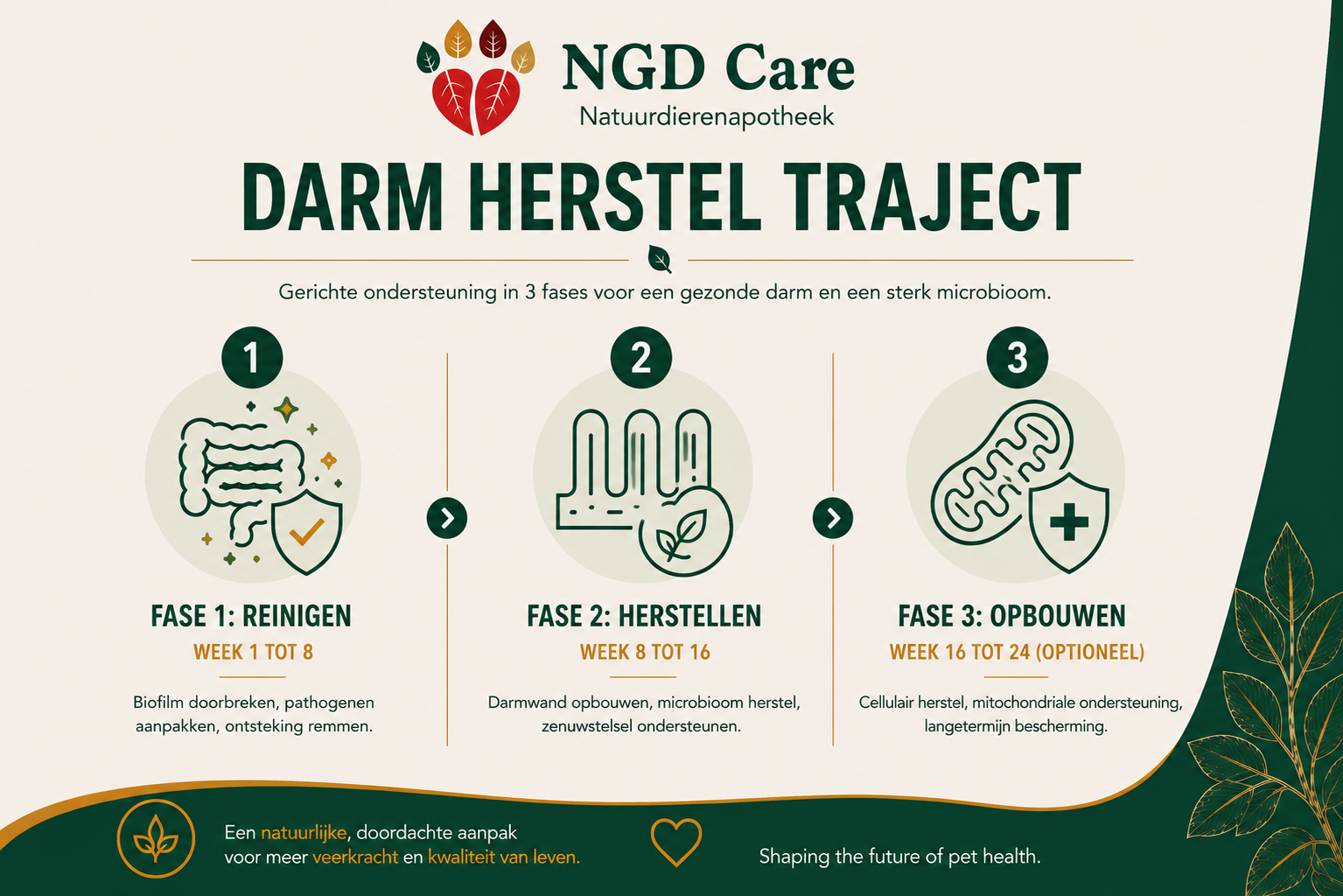
The NGD Care Gut Support Protocol is a three-phase supplement schedule for dogs and cats, formulated for a balanced intestinal flora and normal bowel function. It starts with nutrition and builds further with each phase.
- A three-phase supplement program.
- Starts with a varied, fresh diet as a foundation.
- Formulated for a balanced intestinal flora and normal bowel function.
- Phases 1b and 3 are optional.
Description
QUICK SUMMARY
The Gut Support Program is a three-phase supplement schedule for dogs and cats, designed for a balanced intestinal flora and normal gut function.
Why a program and not a separate supplement?
The gut is an interconnected system. The intestinal flora, the mucus layer, the intestinal wall, and the immune system in and around the gut constantly influence each other. Microorganisms partly live in biofilms, and the cells of the intestinal wall together determine what is and isn’t allowed through. The latter is called intestinal permeability.
A single supplement focuses on one part of this system. A program involves multiple supplements in a fixed order, ensuring every part is addressed.
From a systems biology perspective, the gut is not a separate organ but an ecosystem. That’s why this program looks at the whole, rather than a single substance.
Four processes in and around the gut
The gut is much more than just a tube that food passes through. How it functions is linked to the gut flora, the intestinal wall, the immune system, and connections with the rest of the body. This program was developed from that systems biology perspective.
Billions of bacteria, yeasts, and other microorganisms live in the gut. They consume fibers that dogs and cats cannot digest themselves, converting them into short-chain fatty acids, such as butyric acid. The cells of the large intestine use butyric acid as a vital fuel.
The intestinal wall consists of a single layer of cells that is renewed every few days. The cells are held together by tight junctions and are covered with a layer of mucus. This allows the intestinal wall to determine what is and isn’t allowed through.
A large part of the immune system is located in and around the intestinal wall. Immune cells there are in constant contact with the gut contents, and the intestinal wall releases the IgA antibody into the interior of the gut.
Substances from the gut first enter the liver via the portal vein. The gut and brain are also connected through nerves and signaling molecules. This is why the gut is studied in relation to the liver, skin, and stress response, among others.
Why this order?
Nutrition is the foundation. This is followed by enzymes, antioxidants, and fibers, then building blocks for the intestinal wall and microorganisms, and finally, potentially, cellular energy.
How does the Gut Support Program work?
The program consists of three consecutive phases, with nutrition as the foundation. Each phase builds on the previous one, and the sequence is intentional.
Nutrition is the foundation of what happens in the gut, as the intestinal flora lives on what your pet eats daily. That’s why this program always starts with nutrition. The supplements in the following phases complement that foundation.
Variety in fresh meat as a base: beef, chicken, lamb, game, fish, etc. Preferably raw (BARF, or biologically appropriate raw food, or KVV). Switch protein sources every day to provide as much variety in nutrients for the intestinal flora as possible.
20% ground vegetables added to the meal: zucchini, spinach, broccoli, carrot, pumpkin, etc. Ground and steamed, they are more digestible for dogs and cats. The fibers provide food for the intestinal flora.
Nutrition largely determines which bacteria live in the gut. In a study of 55 healthy dogs, the gut flora of dogs on raw meat differed clearly from those on dry food, and diversity was higher across some of the measures used (Frontiers in Veterinary Science, 2024).
In a randomized 2026 study, 23 dogs were alternately fed lightly cooked fresh food and dry food for two weeks at home. On the fresh food, the number of bacterial species in the stool was higher, and diet proved to be the strongest factor for gut flora composition (Campbell et al., Frontiers in Veterinary Science, 2026).
In the Finnish DogRisk study, a survey involving over 4,500 dogs, a low-processed, meat-rich diet during puppyhood was associated with better gut health later in life, according to the owners (Scientific Reports, 2023).
These are correlations and not yet proof of cause and effect. For us, however, they are a reason to advise fresh, low-processed, and varied diets. Dry food is heated and formed under pressure, and usually contains a lot of starch, as starch is needed to form a kibble.
Want guidance on switching to different food? Schedule an intake with Stefan Veenstra DVM via NatuurlijkGezondeDieren.nl.
The first phase focuses on the contents of the gut itself: the layer where bacteria live, the free radicals formed in the intestinal wall, and the nourishment of the gut flora. Biofilm Balance contains enzymes, NAC, and lactoferrin. Bacteria in the gut partly live in a biofilm, a layer of sugars and proteins they produce themselves, and these substances are studied in relation to that layer. Green Detox contains chlorella, spirulina, and alfalfa. Chlorella has a tough cell wall that research suggests can bind substances in the gut, while spirulina and alfalfa provide chlorophyll, minerals, and phytonutrients. Liposomal Curcumin contains curcumin from turmeric. A large portion of curcumin remains in the gut, where gut bacteria convert it into other substances, and curcumin is studied in relation to the intestinal mucosa. Vitamin C is an antioxidant. Free radicals are formed in the intestinal wall when immune cells react to the gut contents. Prebiotic Fibers contains fibers that gut bacteria ferment into short-chain fatty acids. Of these, butyric acid is the primary fuel for the cells of the colon.
The gut contains a wide variety of microorganisms, including bacteria, yeasts, and other single-celled organisms. Together, these form a complex ecosystem in which microorganisms constantly interact with each other and their environment. Within systems biology, the gut microbiome is therefore viewed as part of a larger whole, in which nutrition, the intestinal wall, and metabolism also play a role.
This optional phase contains three additional formulas with various ingredients. Metabolic Balance combines NAC (N-acetylcysteine) and berberine, two substances with diverse biochemical properties. Pumpkin Seed Blend Intense (dog) and Pumpkin Seed Blend Gentle (cat) contain pumpkin seed oil, MCT oil, quassia extract, and olive leaf extract, among others. Depending on the variant, they also contain small amounts of essential oils. Liposomal Lactoferrin contains lactoferrin, an iron-binding protein naturally found in colostrum, milk, and various body secretions. Many microorganisms require iron, and lactoferrin binds iron tightly.
Phase 1b is a supplement to phase 1a and runs concurrently. It can be selected as a separate component of the Gut Support Program. Each product has its own composition and instructions for use. Due to the concentrated plant-based ingredients and potential interactions with medication, we recommend using this optional phase only in consultation with a veterinarian.
In the second phase, the focus shifts to the intestinal wall itself and the composition of the gut flora. L-Glutamine is the primary fuel for enterocytes, the cells of the intestinal wall. The intestinal wall renews itself every few days, requiring significant energy. Shilajit contains fulvic acid and minerals. Fulvic acid binds minerals and is studied in relation to their absorption in the gut and the gut flora. Vitamin B-Complex provides B vitamins, which are cofactors in energy production. The rapidly dividing cells of the intestinal wall also require folic acid and vitamin B12 for DNA synthesis. Fermented Probiotics contains yeasts and bacteria from water kefir. These microorganisms live temporarily alongside the native gut flora, which is why they are introduced only after the gut has been prepared in phase 1.
Phase 3 is optional and can be added after phases 1 and 2 in consultation. This phase concerns the energy in the intestinal wall cells and the immune system surrounding the gut. Longevity Support contains, among other things, NAD+, a cofactor in cellular energy production. Rapidly renewing cells, such as those of the intestinal wall, consume a lot of NAD+. Coenzyme Q10 is part of the energy production in the mitochondria and also acts as an antioxidant in the cell wall. Glutathione is the most important antioxidant within the cell. The intestinal mucosa contains high levels of glutathione, partly from the diet and partly self-produced. Myco Immune Complex contains beta-glucans from Agaricus, Maitake, Shiitake, and Coriolus. The intestinal wall contains many immune cells, which recognize beta-glucans via the Dectin-1 receptor.
How long does the program take?
Phase 1 and phase 2 together take about 16 weeks. The intestinal wall and flora change gradually, which is why the program is set up over a longer period.
Do you have questions during the program, or want to tailor the schedule to your pet? Schedule an intake with integrative veterinarian Stefan Veenstra.
Frequently asked questions
Can I follow this route without adjusting the diet?
You can, but we don’t recommend it. Nutrition is the first step and the foundation of the entire program, as the intestinal flora lives on what your pet eats daily.
Why does the program take so long?
The cells of the intestinal wall are constantly renewed and the composition of the intestinal flora changes gradually. Therefore, the phases follow each other over a longer period.
Can I follow this program if my pet is on medication?
Consult your vet first. Some supplements should be given separately from medication; this is listed under Dosage and use for each product.
Can my pet have more gas in the beginning?
Yes, fermenting fibers produces gas, so you should build up the amount slowly. If your pet is unwell, contact your veterinarian.
Why the NGD Care Gut Support Program?
| Feature | NGD Care |
|---|---|
| Composition | A schedule with NGD Care supplements, in a fixed order. |
| Human grade | We use human-grade ingredients. |
| Individual guidance | Would you like personal advice for your animal? This is possible via a consultation with Stefan Veenstra. |
Scientific literature
- Slavin J. (2013). Fiber and prebiotics: mechanisms and health benefits. Nutrients.
- Flemming HC, Wingender J. (2010). The biofilm matrix. Nature Reviews Microbiology.
- Cruzat V, et al. (2018). Glutamine: metabolism and immune function, supplementation and clinical translation. Nutrients.
- Laureys D, De Vuyst L. (2014). Microbial species diversity, community dynamics, and metabolite kinetics of water kefir fermentation. Applied and Environmental Microbiology.
Want to read more about nutrients and body processes?
In the knowledge base, you’ll find background articles about nutrition and how the body works. Have a question about this program or want personal advice? Feel free to contact us.
Developed by Stefan Veenstra DVM, integrative veterinarian. Stefan is the founder of NGD Care, NGD Care Academy and Integrative Veterinary Center Natural Healthy Animals. Read more about Stefan →
This information is educational in nature and does not replace a veterinary consultation. In case of severe or persistent complaints, always consult a veterinarian.
Ingredients, dosage and use
- Check the individual supplements for the correct dosage, condition of use, side effects and interactions.
- We recommend giving the therapeutic dosage of 2x daily throughout the entire process.
- The supplements that are in a phase are sufficient for a treatment of 2 months for a dog or cat under 10 kg and for 1 month for a dog of 10 to 30 kg.
-
Disclaimer
- This product is a dietary supplement and not a substitute for a healthy lifestyle and varied balanced diet.
- The products are not medicines and cannot be used as medicines, but as a dietary supplement. In case of illness or other medical condition, always consult a veterinarian before use.
- Dietary supplements may have interactions and side effects with regular medications.
- Keep out of reach of young children.
- Consult an expert before using supplements in case of pregnancy, lactation, medication use and illness.
Reviews
There are no reviews yet.