


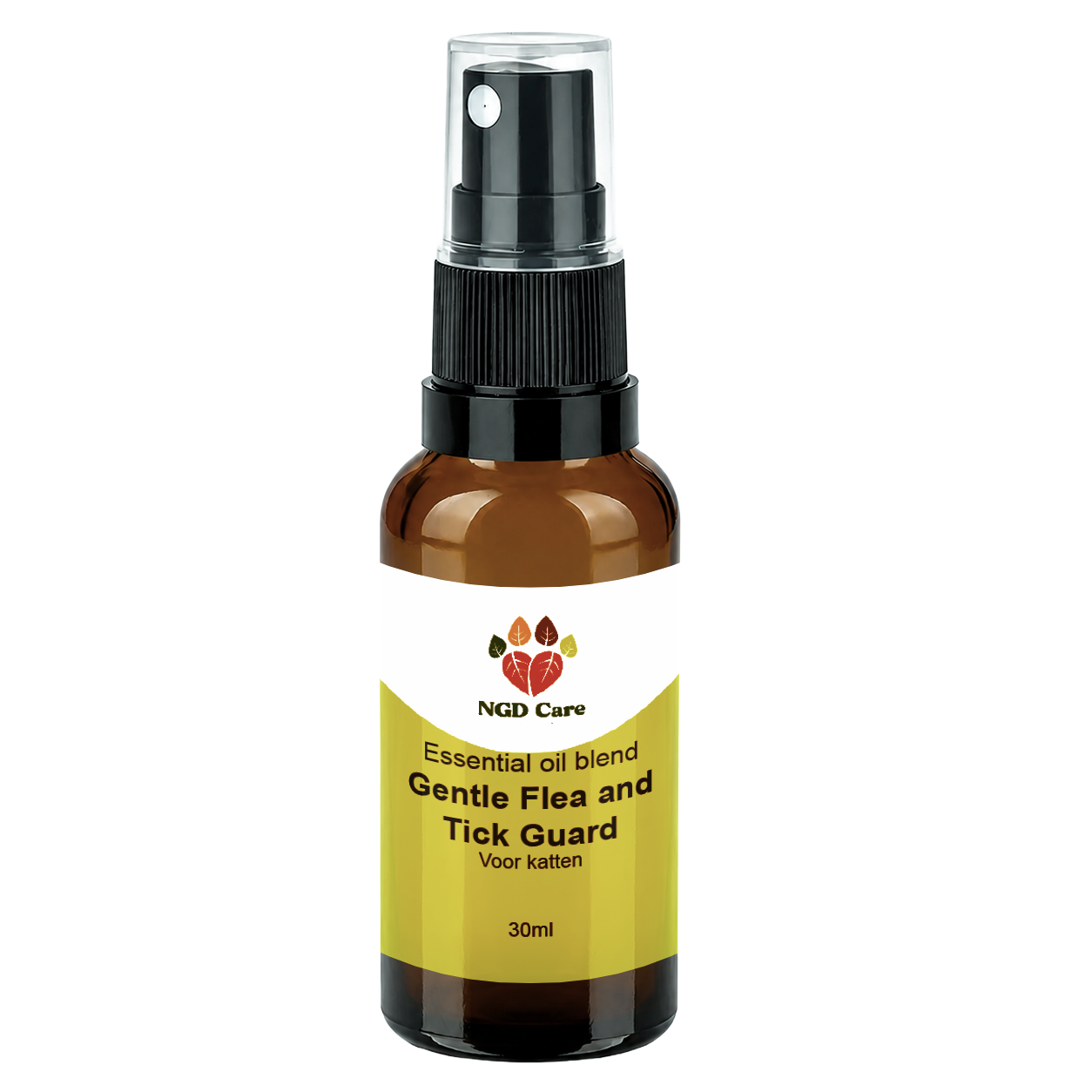
Outdoor Spray Gentle
€ 19,95
NGD Care Outdoor Spray Gentle (formerly Flea and Tick Support Gentle) is a mild coat spray for cats, puppies, and sensitive animals, based on lavender hydrosol with quassia extract, a small amount of neem oil, and a low dosage of cedarwood and geranium.
- Based on lavender hydrosol.
- Low dosage of cedarwood and geranium.
- For cats, puppies, and sensitive animals.
- For external use only.
Description
QUICK SUMMARY
NGD Care Outdoor Spray Gentle is a mild coat spray for cats, puppies, and sensitive animals, based on lavender hydrosol with quassia extract, a small amount of neem oil, and a low dosage of cedarwood and geranium.
What is in this product?
The 30 ml spray contains lavender hydrosol, quassia extract, and neem oil, with a low dosage of cedarwood and geranium essential oils. Excipients are Solubol and Leucidal.
About the ingredients
Lavender hydrosol is the water remaining after the steam distillation of lavender and contains very few fragrances. This makes it a mild base. The essential oils are low-dosed because cats break down many plant substances more slowly than dogs.
How to use this product
Spray into your palm or onto a brush and rub gently over the neck, backline, flanks, and base of the tail. Do not spray directly onto the cat.
Once daily in summer; 1 to 2 times per week during the rest of the year.
Avoid eyes, nose, and mouth. A slight sneezing reaction or extra grooming may occur during the first use.
Frequently asked questions
Is this a flea and tick treatment?
No. This is a mild, caring coat spray with plant extracts. Discuss your flea and tick approach with your veterinarian.
Why spray into the hand first?
This prevents the spray from getting in your cat’s face and ensures your cat is not startled by the sound.
Works well with
A coat spray for dogs with lavender hydrosol, neem oil, quassia extract, and essential oils of clove, palmarosa, lemon eucalyptus, and cedarwood.
A nourishing skin spray for dogs and cats, with colloidal oatmeal, aloe vera, and essential oils of lavender, copaiba, blue tansy, and helichrysum.
Provides EPA and DHA, which are incorporated into cell walls, including those in the brain and skin.
Would you like personal advice for your animal? This is possible via a consultation with Stefan Veenstra.
Want to read more about nutrients and body processes?
In the knowledge base, you will find background articles on nutrition and how the body functions. Do you have a question about this product or would you like personal advice? Please feel free to contact us.
Developed by Stefan Veenstra DVM, integrative veterinarian. Stefan is the founder of NGD Care, NGD Care Academy and Integrative Veterinary Center Natural Healthy Animals. Read more about Stefan →
This information is educational in nature and does not replace a veterinary consultation. In case of severe or persistent complaints, always consult a veterinarian.
Ingredients
Ingredients
- 30ml spray bottle
- Lavender Hydrosol, Quassia Extract, Neem Oil
- Microdosing Cedarwood and Geranium Essential Oil
Additions
- Solubol, Leucidal
Dosage and use
- Cat dosage
- High season
- Spray 1x every day
- Low season
- 1-2× per week
- High season
- Manual
- Spray in palm or on brush/comb
- Gently rub neck, backline, flanks and tail base
- Do not spray directly on cat
- Avoid eyes, nose and mouth
- Side effect
- slight sneeze reaction on first use
- Brief restlessness due to scent stimulus (especially in young cats)
- occasional: mild skin redness or extra washing/licking
Literature
- Nerio, L.S., et al. (2010). Repellent activity of essential oils: A review. Bioresource Technology
- Iqbal, Z., et al. (2014). Geraniol as a natural repellent against external parasites. Veterinary Parasitology
- Ellis, B. et al. (2015). Repellent and toxic effects of cedarwood oils. Journal of Economic Entomology
- Singh, R., et al. (2012). Azadirachtin and neem-based formulations for ectoparasite control. Parasitology Research
- Melo, C.R., et al. (2018). Insecticidal potential of Quassia amara extracts. Industrial Crops & Products
- Baratta, M.T., et al. (1998). Complementary activity between hydrosols and essential oils. Journal of Applied Microbiology
- European Chemicals Agency (ECHA, 2021). Safety profiles of geraniol and cedarwood oil.
Disclaimer
- Essential oils are natural products that can be used to support well-being. They are not a substitute for veterinary care or prescription medication.
- In case of persistent or serious complaints, pregnancy, lactation or in young animals, always consult a veterinarian or qualified therapist.
- Avoid contact with eyes and mucous membranes. Only use according to advice and always apply diluted, unless otherwise indicated.
- Always use essential oils in animals with care. Animals have a different metabolism than humans and can react more sensitively. Always observe your animal after use and stop at signs of hypersensitivity.
Reviews
There are no reviews yet.