


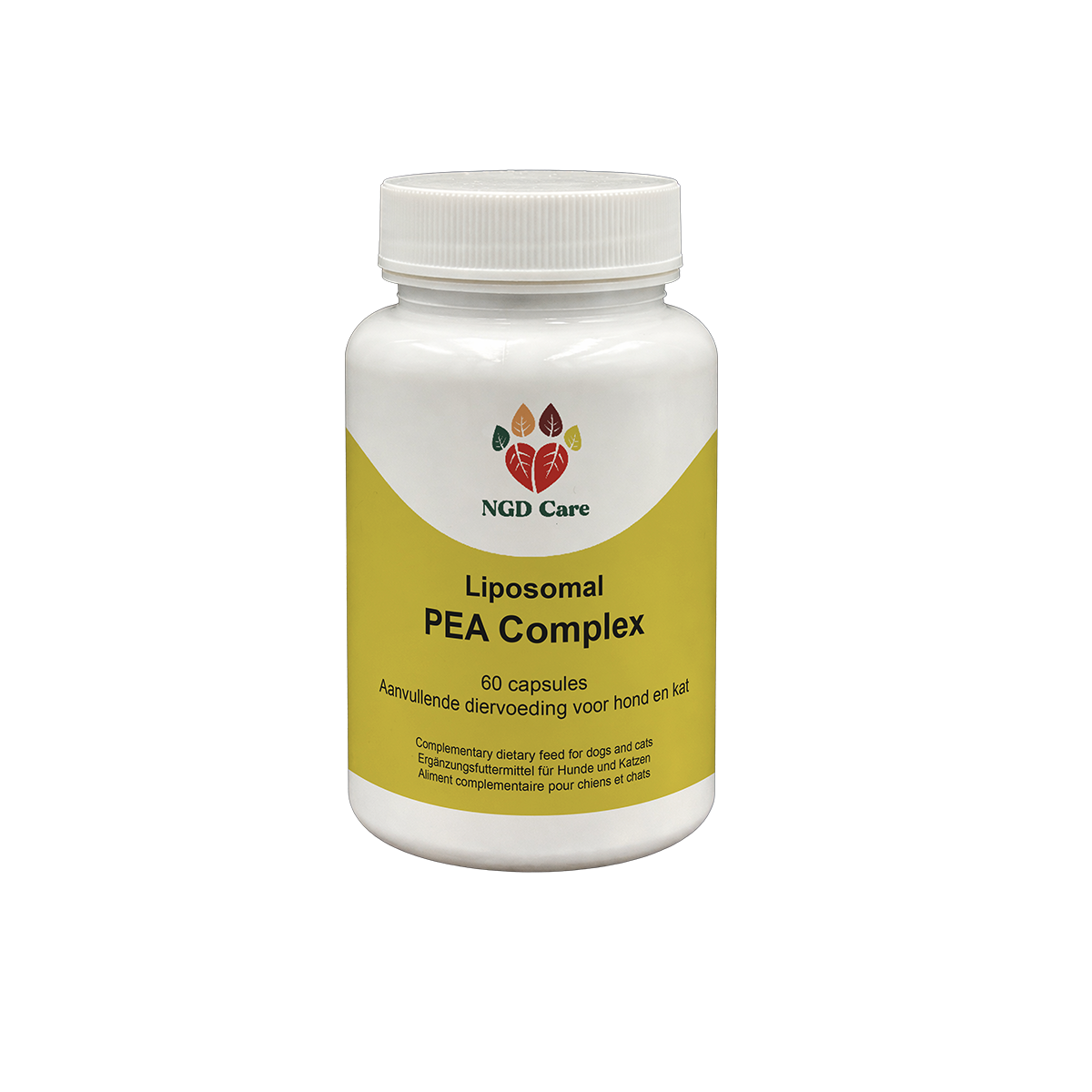
Liposomal PEA complex
€ 47,95
NGD Care PEA Complex is a complementary feed for dogs and cats with 150 mg palmitoylethanolamide (PEA) and 150 mg Boswellia serrata per capsule, in liposomal form. PEA is a fatty acid amide that the body also produces itself. Boswellia is a gum resin from the frankincense tree. This complex is formulated for flexible joints.
- Each capsule contains 150 mg PEA and 150 mg Boswellia serrata.
- PEA is a substance that the body also produces itself.
- The ingredients are chosen for flexible joints.
- The substances are in a liposomal form.
- Description
- Ingredients
- Dosage and use
- Disclaimer
- Scientific literature & substantiation
- Reviews (0)
Description
QUICK SUMMARY
PEA Complex is a complementary feed for dogs and cats with 150 mg palmitoylethanolamide (PEA) and 150 mg Boswellia serrata per capsule, in liposomal form. This complex is formulated for flexible joints.
What’s in this supplement?
Each 400 mg capsule contains 150 mg palmitoylethanolamide (PEA) and 150 mg Boswellia serrata. Both substances are encapsulated by liposomes: small fat bubbles made of sunflower lecithin. The capsule shell is made of HPMC and is therefore plant-based.
What does PEA Complex do?
PEA and Boswellia serrata were chosen to support flexible joints, even as animals age. These two substances work through different pathways in the body, which is why they are combined in one capsule.
The biochemistry per ingredient
PEA (palmitoylethanolamide)
PEA is a fatty substance produced by the body itself from fats in the cell walls. It is also found in food, such as egg yolks and peanuts. The body produces PEA when needed and then quickly breaks it down again using its own enzymes.
PEA acts as a messenger between cells. It fits onto PPAR-alpha, a kind of lock in the cell nucleus. Through that lock, the cell receives a signal about which proteins to produce, including those for fat metabolism and in immune cells. PEA hardly fits onto the cannabinoid receptors CB1 and CB2.
Boswellia serrata
Boswellia is the resin of the frankincense tree. The active substances are called boswellic acids, such as AKBA, and they dissolve in fat. The concentration varies depending on the origin and extract.
Boswellic acids are being studied for their effect on the 5-LOX enzyme. An enzyme is a protein that enables a reaction in the body, and 5-LOX converts certain fatty acids into signaling molecules. PEA works via PPAR-alpha, so these are two different pathways.
How strong is this evidence? The biochemistry of PEA mainly comes from tests with cells and animals. Boswellic acids act strongly on 5-LOX in the laboratory, but in blood, the results are less clear. What this means for dogs and cats at the dosage used does not follow from this.
Frequently asked questions
What is the difference between PEA and CBD?
PEA is a lipid that the body produces itself and that binds to PPAR-alpha. CBD is a cannabinoid from hemp. Both substances are studied within the endocannabinoid system.
Why a liposomal form?
PEA and boswellic acids dissolve poorly in water. Liposomes are small fat bubbles that encapsulate these substances. We choose this form to support absorption.
My pet is on medication. Can I still use PEA Complex?
Consult your vet first. Boswellia can influence cytochrome P450, an enzyme system that breaks down many medications, as well as blood glucose levels.
Why NGD Care PEA Complex?
| Feature | NGD Care |
|---|---|
| Administration form | A vegetable capsule with liposomal content. You can give it whole or open it and mix it through the food. |
| Human grade | We use human-grade ingredients. |
| Clean and green label | The capsule is free from synthetic additives. |
| Individual guidance | Would you like personal advice for your animal? This is possible via a consultation with Stefan Veenstra. |
Works well with
Mobility Support contains building blocks for cartilage, such as glucosamine and chondroitin sulfate. PEA Complex is formulated for flexible joints. In this way, the two products complement each other.
O-Mega Blend contains omega-3 fatty acids, which, like PEA, belong to the lipids. Omega-3 fatty acids are incorporated into cell membranes, from which the body also produces PEA.
Curcumin is a polyphenol from turmeric and, like PEA and boswellic acids, is fat-soluble. Curcumin is studied within different signaling pathways than PEA.
CBD is a cannabinoid from hemp and PEA is a body-own lipid. Both substances are studied within the endocannabinoid system, via different routes.
Part of a protocol
PEA Complex is part of the Joint Support Protocol. A protocol is a schedule in which multiple supplements are given in a fixed order.
Scientific literature
- Okamoto Y, et al. (2004). Molecular characterization of a phospholipase D generating anandamide and its congeners. Journal of Biological Chemistry.
- Tsuboi K, et al. (2005). Molecular characterization of N-acylethanolamine-hydrolyzing acid amidase. Journal of Biological Chemistry.
- O’Sullivan SE. (2016). An update on PPAR activation by cannabinoids. British Journal of Pharmacology.
- Büchele B, et al. (2003). Analysis of pentacyclic triterpenic acids from frankincense gum resins and related phytopharmaceuticals by high-performance liquid chromatography. Journal of Chromatography B.
- Abdel-Tawab M, et al. (2011). Boswellia serrata: an overall assessment of in vitro, preclinical, pharmacokinetic and clinical data. Clinical Pharmacokinetics.
Want to read more about nutrients and body processes?
In the knowledge base, you’ll find background articles on nutrition and how the body works. Do you have a question about this supplement or would you like personal advice? Please feel free to contact us.
Developed by Stefan Veenstra DVM, integrative veterinarian. Stefan is the founder of NGD Care, NGD Care Academy and Integrative Veterinary Center Natural Healthy Animals. Read more about Stefan →
This information is educational in nature and does not replace a veterinary consultation. In case of severe or persistent complaints, always consult a veterinarian.
Ingredients
- Ingredients
- Palmitoylethanolamide, Boswellia Serrata
- Composition per capsule of 400mg
- 150mg Boswellia serrata
- 150mg Palmitoylethanolamide (PEA)
- Additions
- Lipodry liposome: sunflower lecithin
- HPMC vega capsule
Dosage and use
- Dosage dog and cat
- Starting dosage
- on the advice of a veterinarian or therapist
- <10kg 2xdaily 1/2 capsule
- 10-30kg 1 capsule 2xdaily
- >30kg 2x daily 2 capsules
- Maintenance Dosing
- <10kg 1x daily 1/2 capsule
- 10-30kg 1x daily 1 capsule
- >30kg 2 capsules 1x day
- Starting dosage
- Manual
- Capsules can be administered opened or whole through food.
- Store in a dry, sealed and room temperature.
- Capsules can be administered opened or whole through food.
- Contraindications
- no known contraindications
- Side effects
- Upset stomach, diarrhea, skin reactions, and headaches have rarely been observed.
- Interactions
- Boswellia can affect blood glucose levels
- Boswellia inhibits Cytochrome P450, which can slow the breakdown of NSAIDs, blood thinners, and diabetes medications.
Disclaimer
- This product is a dietary supplement and not a substitute for a healthy lifestyle and varied balanced diet.
- The products are not medicines and cannot be used as medicines, but as a dietary supplement. In case of illness or other medical condition, always consult a veterinarian before use.
- Dietary supplements may have interactions and side effects with regular medications.
- Keep out of reach of young children.
- Consult an expert before using supplements in case of pregnancy, lactation, medication use and illness.
Scientific literature & substantiation
- PEA for pain and inflammation
- PEA has anti-inflammatory, analgesic, and neuroprotective properties.
- Source: Keppel Hesselink, J. M., et al. (2013). Palmitoylethanolamide, a natural neuroprotective agent in nerve compression syndromes. Pain Physician
- PEA for glaucoma
- PEA lowers intraocular pressure and protects retinal cells.
- Source: Bucolo, C., et al. (2011). Palmitoylethanolamide reduces intraocular pressure and protects the retina in a glaucoma model. Journal of Cellular and Molecular Medicine
- Boswellia for inflammation and pain
- Boswellia extract reduces joint pain and inflammatory markers in chronic conditions.
- Source: Sengupta, K., et al. (2008). A double blind, randomized, placebo controlled study of the efficacy and safety of 5-Loxin for treatment of osteoarthritis of the knee. Arthritis Research & Therapy
- Synergistic effect PEA + Boswellia
- Combination inhibits pain and inflammatory pathways on multiple levels.
- Source: Impellizzeri, D., et al. (2014). Palmitoylethanolamide and Boswellia serrata: a new possible treatment for chronic pain. European Review for Medical and Pharmacological Sciences
- Boswellia and medication interactions
- Boswellia affects cytochrome P450 and glucose management.
- Source: Sharma, M. L., & Bani, S. (1990). Boswellic acids: anti-inflammatory and immunomodulatory agents. Planta Medica
Reviews
There are no reviews yet.