


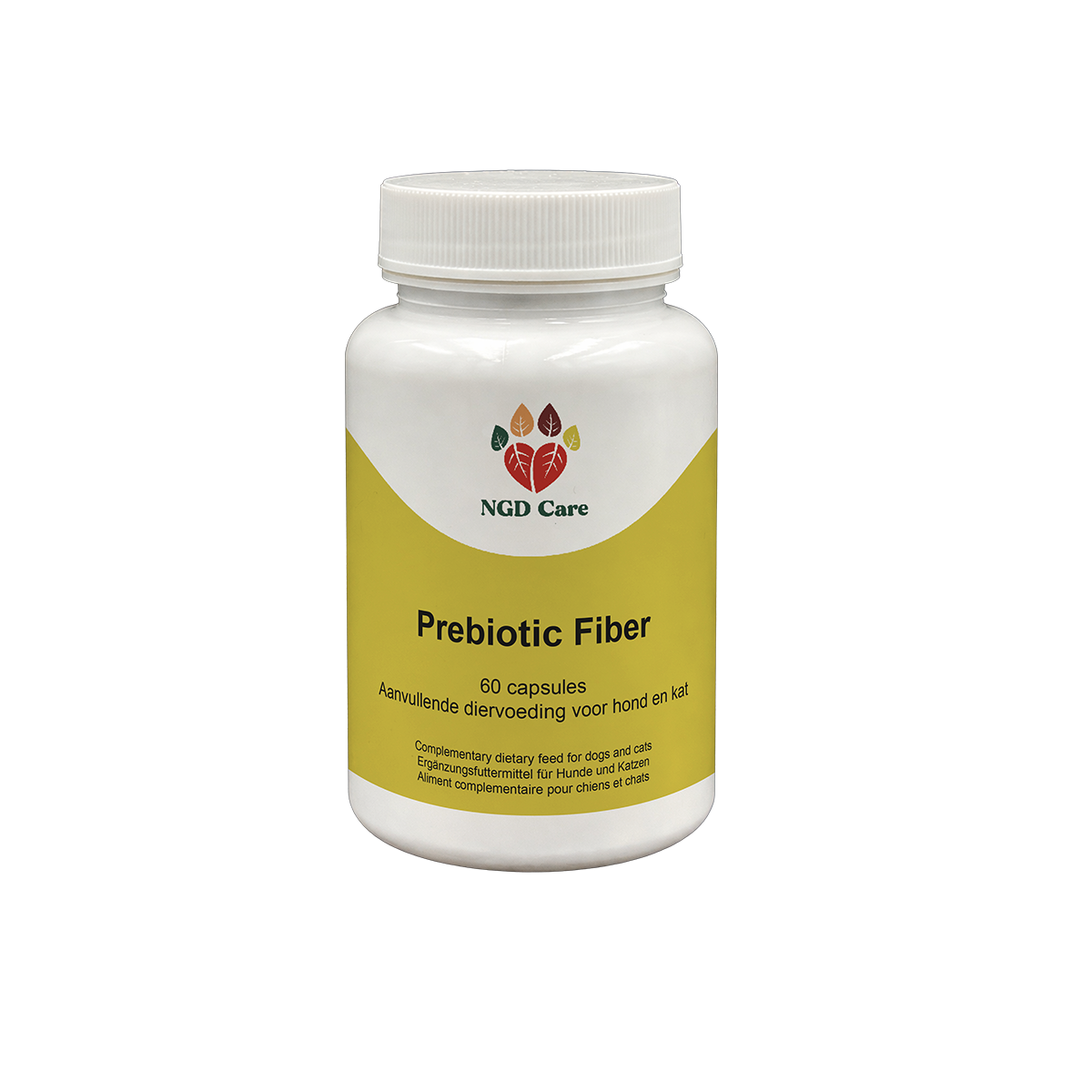
Prebiotic fiber
€ 44,95
NGD Care Prebiotic Fibers is a complementary feed for dogs and cats with chicory root, acacia root, Agaricus blazei and Saccharomyces boulardii. Prebiotic fibers serve as food for gut bacteria and support a balanced intestinal flora.
- Contains chicory root, acacia, Agaricus blazei and S. boulardii.
- A gastro-resistant capsule that you give whole.
- You can give the capsule with food or separately.
- Is suitable for long-term use in dogs and cats.
- Description
- Ingredients
- Dosage and use
- Disclaimer
- Scientific literature & substantiation
- Reviews (0)
Description
QUICK SUMMARY
Prebiotic Fibers is a complementary feed for dogs and cats with various fibers. Prebiotic fibers serve as food for gut bacteria and support a balanced intestinal flora.
What’s in this supplement?
Each 433 mg capsule contains 217 mg chicory root, 130 mg acacia root, 43 mg Agaricus blazei and 43 mg Saccharomyces boulardii. The shell is a gastro-resistant HPMC capsule.
What does Prebiotic Fibers do?
Prebiotic Fibers contains fibers that serve as food for gut bacteria and support a balanced intestinal flora. The different fibers are fermented at different rates.
The biochemistry per ingredient
How prebiotic fibers work
Dogs and cats cannot digest these fibers themselves, so they reach the large intestine largely undigested. There, gut bacteria consume them and produce short-chain fatty acids, such as butyric acid. This process also produces gas, which is why you should increase the dosage gradually.
Chicory root
Chicory root contains inulin and FOS (fructo-oligosaccharides). These are chains of fructose units, primarily researched in relation to Bifidobacterium and Lactobacillus. They are among the best-studied prebiotic fibers.
Acacia root
Acacia contains arabinogalactans, branched sugar chains that are fermented slowly. A wide range of gut bacteria can break them down, including species that produce butyric acid. The cells of the large intestine use butyric acid as an important fuel.
Agaricus blazei and Saccharomyces boulardii
Agaricus blazei is a mushroom with beta-glucans, sugar chains from the cell wall. Saccharomyces boulardii is a yeast, and its cell wall also contains sugar chains, such as MOS (mannan-oligosaccharides).
How strong is this evidence? The fermentation of these fibers is well-documented. Research in dogs and cats has mainly focused on inulin and other fructans, and less on this specific combination.
Frequently asked questions
What is the difference between prebiotics, probiotics and postbiotics?
Probiotics are live microorganisms that you add to the diet. Prebiotics are fibers that serve as food for the bacteria already living in the gut. Postbiotics are substances produced when bacteria ferment fibers, such as butyric acid. The term is also used for non-living microorganisms and their components. Prebiotic Fibers contains prebiotic fibers, and their fermentation produces short-chain fatty acids, among other things.
Can I open the capsule?
It is better to give the capsule whole, as it is a gastro-resistant capsule.
My pet is on medication. Can I still use Prebiotic Fibers?
Consult your veterinarian first, especially in the case of blood thinners or blood sugar medication.
Why NGD Care Prebiotic Fibers?
| Feature | NGD Care |
|---|---|
| Administration | A gastro-resistant capsule that you give whole. |
| Human grade | We use human-grade ingredients. |
| Clean and green label | The capsule is free from synthetic additives. |
| Individual guidance | Would you like personal advice for your animal? This is possible via a consultation with Stefan Veenstra. |
Works well with
Fermented Probiotics contains yeasts and bacteria from water kefir. Prebiotic fibers serve as food for gut bacteria.
Gut Support contains microorganisms and nutrients, including the fiber pectin.
L-glutamine is a fuel for the cells of the intestinal wall.
Part of a protocol
Prebiotic Fibers is part of the Gut Support Protocol. A protocol is a schedule in which multiple supplements are given in a fixed order.
Scientific literature
- Slavin J. (2013). Fiber and prebiotics: mechanisms and health benefits. Nutrients.
- Gibson GR, et al. (2017). Expert consensus document: the International Scientific Association for Probiotics and Prebiotics (ISAPP) consensus statement on the definition and scope of prebiotics. Nature Reviews Gastroenterology and Hepatology.
Want to read more about nutrients and body processes?
In the knowledge base, you’ll find background articles on nutrition and how the body works. Do you have a question about this supplement or would you like personal advice? Please feel free to contact us.
Developed by Stefan Veenstra DVM, integrative veterinarian. Stefan is the founder of NGD Care, NGD Care Academy and Integrative Veterinary Center Natural Healthy Animals. Read more about Stefan →
This information is educational in nature and does not replace a veterinary consultation. In case of severe or persistent complaints, always consult a veterinarian.
Ingredients
- Ingredients
- Chicory root, acacia root, Agaricus Blazei, Saccharomyces Boulardii
- Composition per capsule of 433mg
- 217mg Chicory root
- 130mg Acacia Root
- 43mg Agaricus Blazei
- 43mg Sacharomyces Boulardii
- Additions
- HPMC enteric-coated vega capsule
Dosage and use
- Dosage dog and cat
- Starting dosage
- For a maximum of 6-8 weeks on the advice of a veterinarian or therapist
- <10kg 1x daily 1 capsule
- 10-30kg 1 capsule 2xdaily
- >30kg 2x daily 2 capsules
- Maintenance Dosing
- <10kg 1 capsule every other day
- 10-30kg 1x daily 1 capsule
- >30kg 2 capsules 1x day
- Starting dosage
- Manual
- Give capsule whole in the food or loose from the food in the mouth.
- Store in a dry, sealed and room temperature store
- Contraindications
- none known
- Side effects
- Temporary bloating or flatulence possible. If that happens start the dosage more slowly.
- Change in stool pattern in the first days
- Interactions
- May affect the action of blood thinners
- May lower blood sugar levels in animals with diabetes
Disclaimer
- This product is a dietary supplement and not a substitute for a healthy lifestyle and varied balanced diet.
- The products are not medicines and cannot be used as medicines, but as a dietary supplement. In case of illness or other medical condition, always consult a veterinarian before use.
- Dietary supplements may have interactions and side effects with regular medications.
- Keep out of reach of young children.
- Consult an expert before using supplements in case of pregnancy, lactation, medication use and illness.
Scientific literature & substantiation
- Effect of prebiotics on the intestinal flora
- Inulin and FOS increase the population of bifidobacteria and improve microbial balance.
- Source: Slavin, J. (2013). Fiber and prebiotics: mechanisms and health benefits. Nutrients.
- Arabinogalactans and immune function
- Acacia fiber contains arabinogalactans that stimulate both the microbiome and immune response.
- Source: D’Adamo, P. J., & Kelly, G. S. (2001). Glycoproteins in innate immunity. Alternative Medicine Review
- MOS from Saccharomyces boulardii
- MOS can bind and excrete pathogenic bacteria, as well as improve gut health.
- Source: Spring, P., et al. (2000). Mannan-oligosaccharides in animal nutrition. Proceedings of the 61st Minnesota Nutrition Conference.
- Beta-glucans from Agaricus blazei
- Beta-glucans stimulate macrophages and NK cells and support gut immunity.
- Source: Hetland, G., et al. (2008). The mushroom Agaricus blazei Murill in immunotherapy. Current Topics in Nutraceutical Research.
- Prebiotics after antibiotics and medication
- Prebiotic fibers help restore the intestinal flora after the use of antibiotics, pesticides or dewormers.
- Source: Gibson, G. R., & Roberfroid, M. B. (1995). Dietary modulation of the human colonic microbiota: introducing the concept of prebiotics. Journal of Nutrition

Reviews
There are no reviews yet.