

Skin Support
€ 49,95
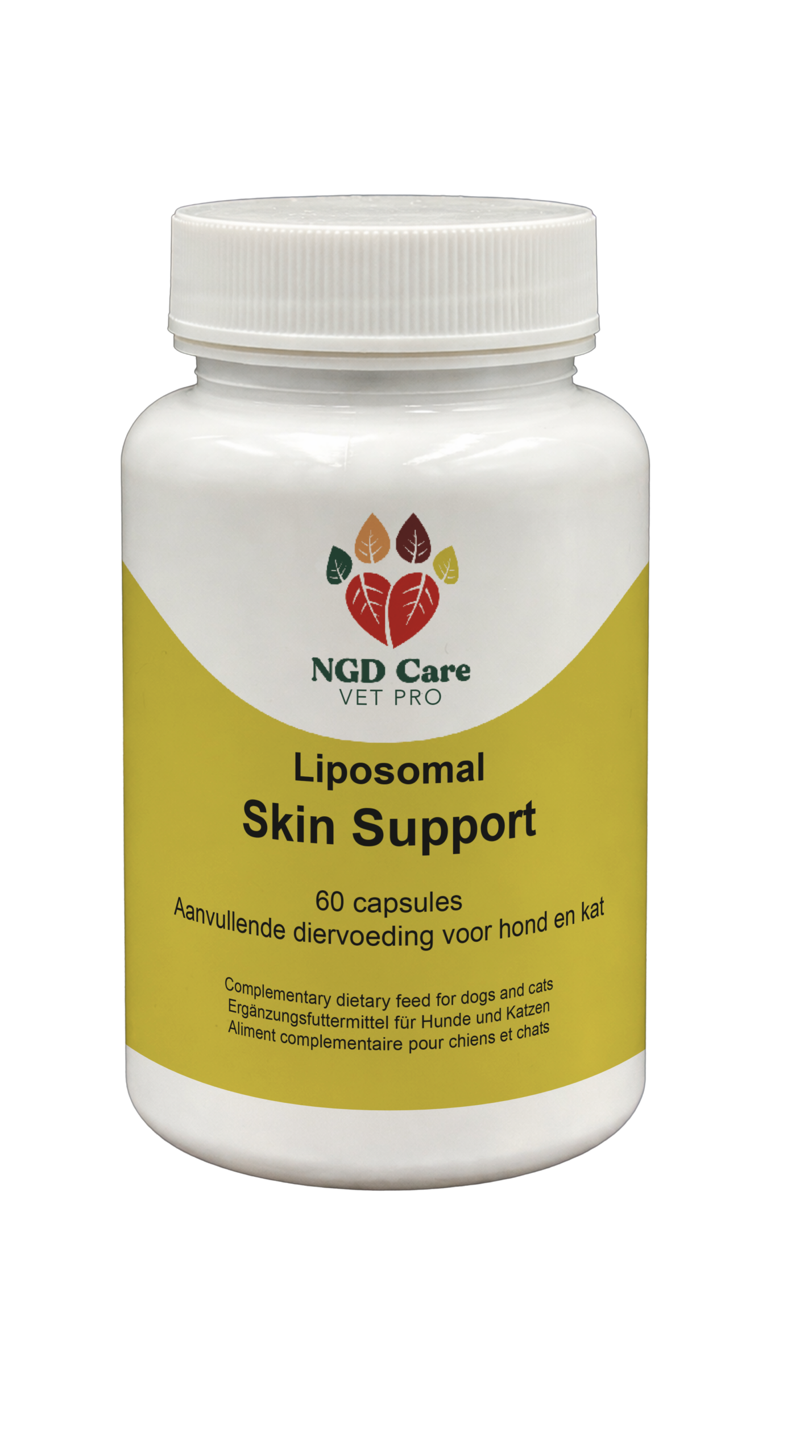
NGD Care Skin Support is a complementary feed for dogs and cats with PEA, quercetin, MSM, vitamin C, zinc carnosine, and biotin. Zinc and biotin contribute to the maintenance of normal skin, and vitamin C contributes to normal collagen formation.
- Contains PEA, quercetin, MSM, vitamin C, zinc, and biotin.
- PEA, quercetin, and vitamin C are in liposomal form.
- You can also open the capsule and mix it with food.
- Suitable for dogs and cats.
Description
QUICK SUMMARY
Skin Support is a complementary feed for dogs and cats with PEA, quercetin, MSM, vitamin C, zinc carnosine, and biotin. Zinc and biotin contribute to the maintenance of normal skin.
What’s in this supplement?
Each capsule contains 150 mg MSM, 125 mg liposomal PEA, 75 mg liposomal quercetin, 37.5 mg liposomal vitamin C, 2.5 mg zinc carnosine, and 125 micrograms of biotin.
What does Skin Support do?
Skin Support combines nutrients the skin needs for daily renewal with PEA and quercetin. The ingredients are chosen for healthy skin and coat.
The biochemistry per ingredient
PEA
PEA is a fatty substance produced by the body that acts as a messenger between cells. It fits onto PPAR-alpha, a kind of lock in the cell nucleus. PEA is being researched in mast cells, immune cells that are also found in the skin.
Quercetin
Quercetin is a plant substance from the flavonoids group, found in onions and apples, among others. It dissolves poorly in water. Quercetin is also being researched in mast cells.
MSM
MSM stands for methylsulfonylmethane and is a source of sulfur. Sulfur is found in the amino acids methionine and cysteine, and thus also in keratin, the protein of hair and skin.
Vitamin C
The skin largely consists of collagen, a strong protein. Enzymes need vitamin C to properly assemble collagen.
Zinc and biotin
The outer skin layer is constantly renewed. Zinc is needed for enzymes involved in cell division. Biotin is the cofactor for enzymes that produce fatty acids, and fats form the cement between skin cells.
How strong is this evidence? The role of zinc, biotin, and vitamin C in the skin is well-established. Data on PEA, quercetin, and mast cells come mainly from cell and animal trials, with limited research in dogs.
Safety
Does your animal suddenly develop swelling on the head or difficulty breathing? Go to the vet immediately. This supplement is not intended for this.
Frequently asked questions
Why are PEA and quercetin liposomal?
PEA and quercetin dissolve poorly in water. Liposomes are small fat globules that surround these substances. We choose this form to support absorption.
Why give it for a longer period?
The skin renews itself continuously. That’s why Skin Support is well-suited for daily use over a longer period.
My animal is on medication. Can I still use Skin Support?
Consult your vet first. The ‘Dosage and use’ section lists which combinations require attention.
Why NGD Care Skin Support?
| Feature | NGD Care |
|---|---|
| Form of administration | A capsule that you can give whole or open and mix with food. |
| Human grade | We use human-grade ingredients. |
| Clean and green label | The capsule is free from synthetic additives. |
| Individual guidance | Would you like personal advice for your animal? This is possible via a consultation with Stefan Veenstra. |
Works well with
Omega-3 fatty acids are incorporated into the membranes of skin cells.
Gut Support is formulated for the gut flora and Skin Support for skin and coat.
Curcumin and quercetin are both plant polyphenols, with a different chemical structure.
Lactoferrin is an iron-binding protein naturally found in colostrum and saliva.
Part of a protocol
Skin Support is part of the Skin Support Protocol. A protocol is a schedule in which multiple supplements are given in a fixed order.
Scientific literature
- Proksch E, et al. (2008). The skin: an indispensable barrier. Experimental Dermatology.
- Pullar JM, et al. (2017). The roles of vitamin C in skin health. Nutrients.
- Butawan M, et al. (2017). Methylsulfonylmethane: applications and safety of a novel dietary supplement. Nutrients.
- Anand David AV, et al. (2016). Overviews of biological importance of quercetin: a bioactive flavonoid. Pharmacognosy Reviews.
- O’Sullivan SE. (2016). An update on PPAR activation by cannabinoids. British Journal of Pharmacology.
Want to read more about nutrients and body processes?
In the knowledge base, you’ll find background articles on nutrition and how the body works. Do you have a question about this supplement or would you like personal advice? Please feel free to contact us.
Developed by Stefan Veenstra DVM, integrative veterinarian. Stefan is the founder of NGD Care, NGD Care Academy and Integrative Veterinary Center Natural Healthy Animals. Read more about Stefan →
This information is educational in nature and does not replace a veterinary consultation. In case of severe or persistent complaints, always consult a veterinarian.
Ingredients
- Ingredients
- PEA, quercetin, MSM, vitamin C, zinc, biotin.
- Composition per capsule
- 150 mg MSM 300 mg
- 125 mg liposomal PEA
- 75 mg liposomal quercetin
- 37.5 mg liposomal vitamin C
- 2.5 mg zinc carnosine
- 125 mcg biotin
Dosage and use
- Dosage dog and cat
- Starting dose 2x daily, maintenance dose 1x daily 1 capsule per 10 kg.
Body weight Capsules per dose Up to 5 kg ½ capsule 5 to 15 kg 1 capsule 15 to 25 kg 2 capsules 25 to 35 kg 3 capsules 35 to 45 kg 4 capsules
- Starting dose 2x daily, maintenance dose 1x daily 1 capsule per 10 kg.
- Manual
- Capsule can be given whole or opened and mixed with food.
- Contraindications
- none
- Side effects
- none
- Interactions
- Cyclosporine (Atopica): in laboratory research, quercetin inhibits the enzyme CYP3A4 and the transporter P-glycoprotein, which may increase cyclosporine levels. Use only in consultation with a veterinarian.
- Tetracyclines and fluoroquinolones: zinc can reduce absorption. Administer at least 2 hours apart.
Disclaimer
- This product is a dietary supplement and not a substitute for a healthy lifestyle and varied balanced diet.
- The products are not medicines and cannot be used as medicines, but as a dietary supplement. In case of illness or other medical condition, always consult a veterinarian before use.
- Dietary supplements may have interactions and side effects with regular medications.
- Keep out of reach of young children.
- Consult an expert before using supplements in case of pregnancy, lactation, medication use and illness.