

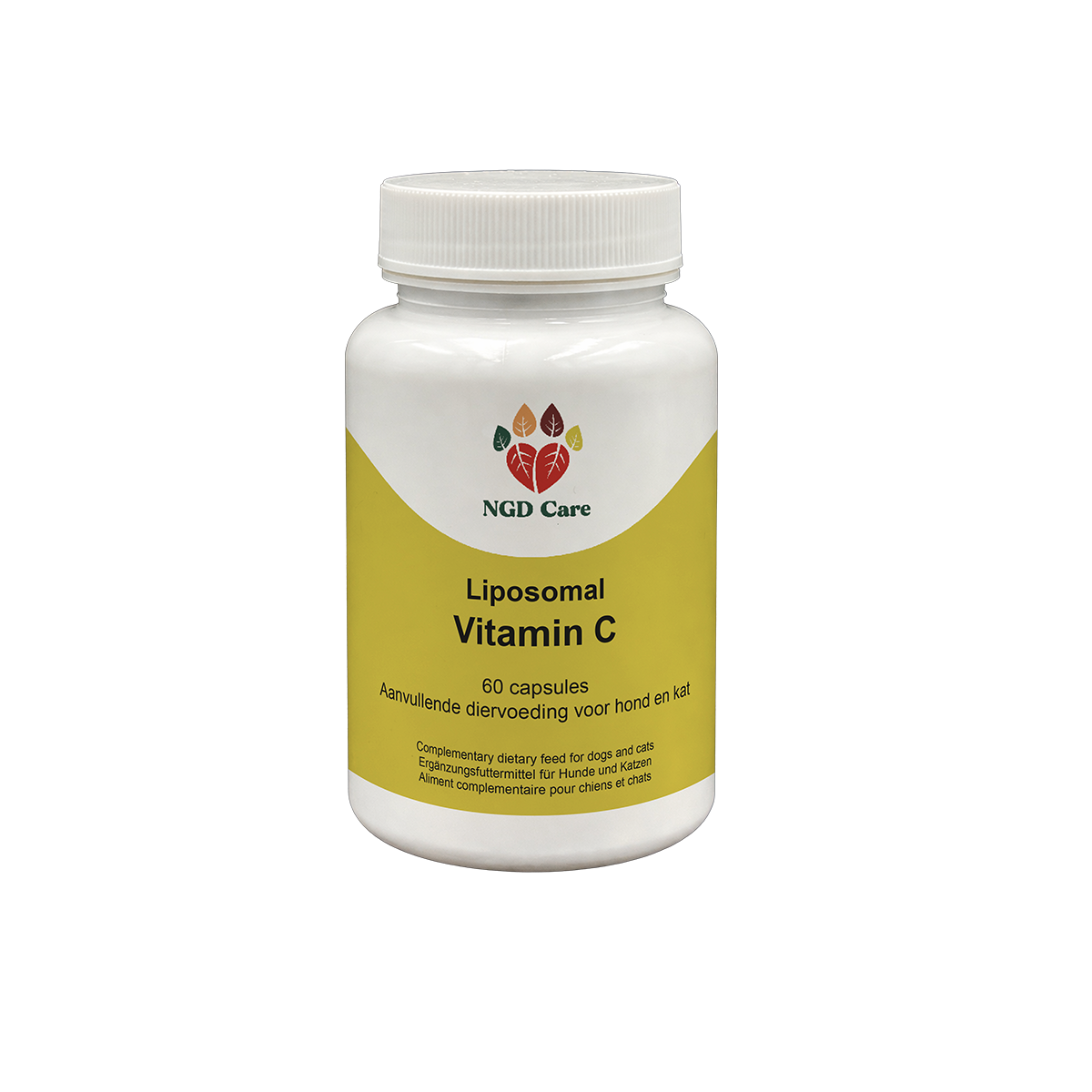
Liposomal Vitamin C
€ 32,95
NGD Care Liposomal Vitamin C is a complementary feed for dogs and cats with 300 mg of vitamin C per capsule. Vitamin C contributes to normal collagen formation for skin, bones, and cartilage, to the normal function of the immune system, and to the protection of cells against oxidative stress.
- Each capsule contains 300 mg of vitamin C.
- Vitamin C contributes to normal collagen formation.
- Vitamin C contributes to the normal function of the immune system.
- The vitamin C is in a liposomal form.
- Description
- Ingredients
- Dosage and use
- Disclaimer
- Scientific literature & substantiation
- Reviews (0)
Description
QUICK SUMMARY
Liposomal Vitamin C is a complementary feed for dogs and cats with 300 mg of vitamin C per capsule. Vitamin C contributes to normal collagen formation, the normal function of the immune system, and the protection of cells against oxidative stress.
What’s in this supplement?
Each capsule contains 300 mg of ascorbic acid, the chemical name for vitamin C. The vitamin C is encapsulated in liposomes: tiny fat bubbles made from sunflower lecithin. The capsule shell is made of HPMC and is therefore plant-based.
What does Liposomal Vitamin C do?
Vitamin C is needed in various places in the body: for the production of collagen, in immune cells, and for scavenging free radicals. Liposomal Vitamin C supplements the diet and what dogs and cats produce themselves.
The biochemistry per ingredient
Collagen
Collagen is a strong protein that you can think of as a rope. It holds skin, bones, cartilage, and blood vessels together. To make that rope strong, enzymes must link small groups to the protein chains. Those enzymes can only do their job with vitamin C as a cofactor.
Antioxidant
Free radicals, substances that can damage cells, are constantly formed in the cell. Vitamin C easily gives up an electron and thus scavenges these substances. Glutathione can then return the used vitamin C to its active form. Vitamin E also becomes usable again with the help of vitamin C.
Immune cells
Immune cells such as neutrophils and lymphocytes contain much more vitamin C than the blood. They actively take up the vitamin using their own transport proteins.
Energy
The body also uses vitamin C in the production of carnitine. Carnitine brings fatty acids to the mitochondria, the cell’s energy factories.
Natural production
Dogs and cats produce vitamin C themselves in the liver, from glucose. Humans cannot do this. In dogs and cats, vitamin C also comes from their diet.
How strong is this evidence? The role of vitamin C in collagen formation and protection against free radicals is well established. Most research has been done in humans and laboratory animals. Less research has been done in dogs and cats.
Frequently asked questions
Why give vitamin C if the body produces it itself?
Dogs and cats produce their own vitamin C. This supplement provides vitamin C as a boost to that natural production and the diet.
Why liposomal vitamin C?
Liposomes are tiny fat bubbles that encapsulate the vitamin C. In this capsule, they are made from sunflower lecithin. We choose this form to support absorption.
Can I combine vitamin C with glutathione?
Yes. Vitamin C and glutathione both belong to the body’s antioxidant system. Glutathione can return oxidized vitamin C to its active form.
My pet is on medication. Is vitamin C still okay?
Consult your vet first. The ‘Dosage and use’ section lists which combinations require attention.
Why NGD Care Liposomal Vitamin C?
| Feature | NGD Care |
|---|---|
| Administration form | A vegetable capsule with liposomal content. You can give it whole or open it and mix it through the food. |
| Human grade | We use human-grade ingredients. |
| Clean and green label | The capsule is free from synthetic fillers. |
| Flavors and fragrances | No flavors or fragrances have been added. |
| Animal by-products | The product is free from animal by-products. |
| Individual guidance | Would you like personal advice for your animal? This is possible via a consultation with Stefan Veenstra. |
Works well with
Glutathione is the most important antioxidant inside the cell. Glutathione can return oxidized vitamin C to its active form. Thus, both substances belong to the same antioxidant system.
Mobility Support provides building blocks for cartilage and joints. Vitamin C contributes to normal collagen formation for the normal function of cartilage.
Lactoferrin is an iron-binding protein naturally found in colostrum and saliva. Vitamin C contributes to the normal function of the immune system.
Curcumin is a fat-soluble polyphenol from turmeric. Vitamin C is water-soluble. Thus, the two substances complement each other in the watery and fatty parts of the cell.
Scientific literature
- Pullar JM, et al. (2017). The roles of vitamin C in skin health. Nutrients.
- Carr AC, Maggini S. (2017). Vitamin C and immune function. Nutrients.
Want to read more about nutrients and body processes?
In the knowledge base, you’ll find background articles on nutrition and how the body works. Do you have a question about this supplement or would you like personal advice? Please feel free to contact us.
Developed by Stefan Veenstra DVM, integrative veterinarian. Stefan is the founder of NGD Care, NGD Care Academy and Integrative Veterinary Center Natural Healthy Animals. Read more about Stefan →
This information is educational in nature and does not replace a veterinary consultation. In case of severe or persistent complaints, always consult a veterinarian.
Ingredients
- Ingredients
- Ascorbic acid
- Composition per capsule of 400mg
- 300mg Ascorbic Acid
- Additions
- Lipodry liposome: sunflower lecithin
- HPMC vega capsule
Dosage and use
- Dosage dog and cat
- Starting dosage
- on the advice of a veterinarian or therapist
- <10kg 2xdaily 1/2 capsule
- 10-30kg 1 capsule 2xdaily
- >30kg 2x daily 2 capsules
- Maintenance Dosing
- <10kg 1x daily 1/2 capsule
- 10-30kg 1x daily 1 capsule
- >30kg 2 capsules 1x day
- Manual
- Capsules can be administered opened or whole through food.
- Store in a dry, sealed and room temperature.
- Contraindications
- Do not use in diabetes without consultation: vitamin C can affect blood sugar levels (increasing or stabilizing, depending on dose and situation).
- Caution in animals with an increased risk of kidney stones.
- Side effects
- At high doses: stomach cramps, diarrhea, nausea, headache
- Long-term overdose: increased risk of oxalate stones in bladder or kidneys
- Interactions
- May increase the absorption of aluminium (e.g. from antacids)
- Increases the absorption of levothyroxine (thyroid medication)
- May affect the action of certain chemotherapeutic drugs
Disclaimer
- This product is a dietary supplement and not a substitute for a healthy lifestyle and varied balanced diet.
- The products are not medicines and cannot be used as medicines, but as a dietary supplement. In case of illness or other medical condition, always consult a veterinarian before use.
- Dietary supplements may have interactions and side effects with regular medications.
- Keep out of reach of young children.
- Consult an expert before using supplements in case of pregnancy, lactation, medication use and illness.
Scientific literature & substantiation
- Vitamin C and immune system
- Vitamin C promotes phagocytosis, T-cell activity and supports immunity to infection and stress.
- Source: Carr, A. C., & Maggini, S. (2017). Vitamin C and immune function. Nutrients
- Vitamin C and collagen synthesis
- Essential coenzyme for hydroxylation of proline and lysine in collagen.
- Source: Pullar, J. M., et al. (2017). The roles of vitamin C in skin health. Nutrients
- Liposomal Vitamin C and Absorption
- Liposomal form significantly increases bioavailability compared to conventional oral forms.
- Source: Hickey, S., & Roberts, H. (2005). Liposomal vitamin C: Enhanced absorption and bioavailability. Medical Hypotheses
- Vitamin C and oxidative stress/detoxification
- Plays an important role in protecting against oxidative damage and chelation of metals.
- Source: Duarte, T. L., & Lunec, J. (2005). Review: When is an antioxidant not an antioxidant? A review of novel actions and reactions of vitamin C . Free Radical Research
- Vitamin C and kidney stones
- Chronic high intake may increase the risk of calcium oxalate stones.
- Source: Thomas, L. D., et al. (2013). Ascorbic acid supplements and kidney stone incidence among men: a prospective study. JAMA Internal Medicine
Reviews
There are no reviews yet.