


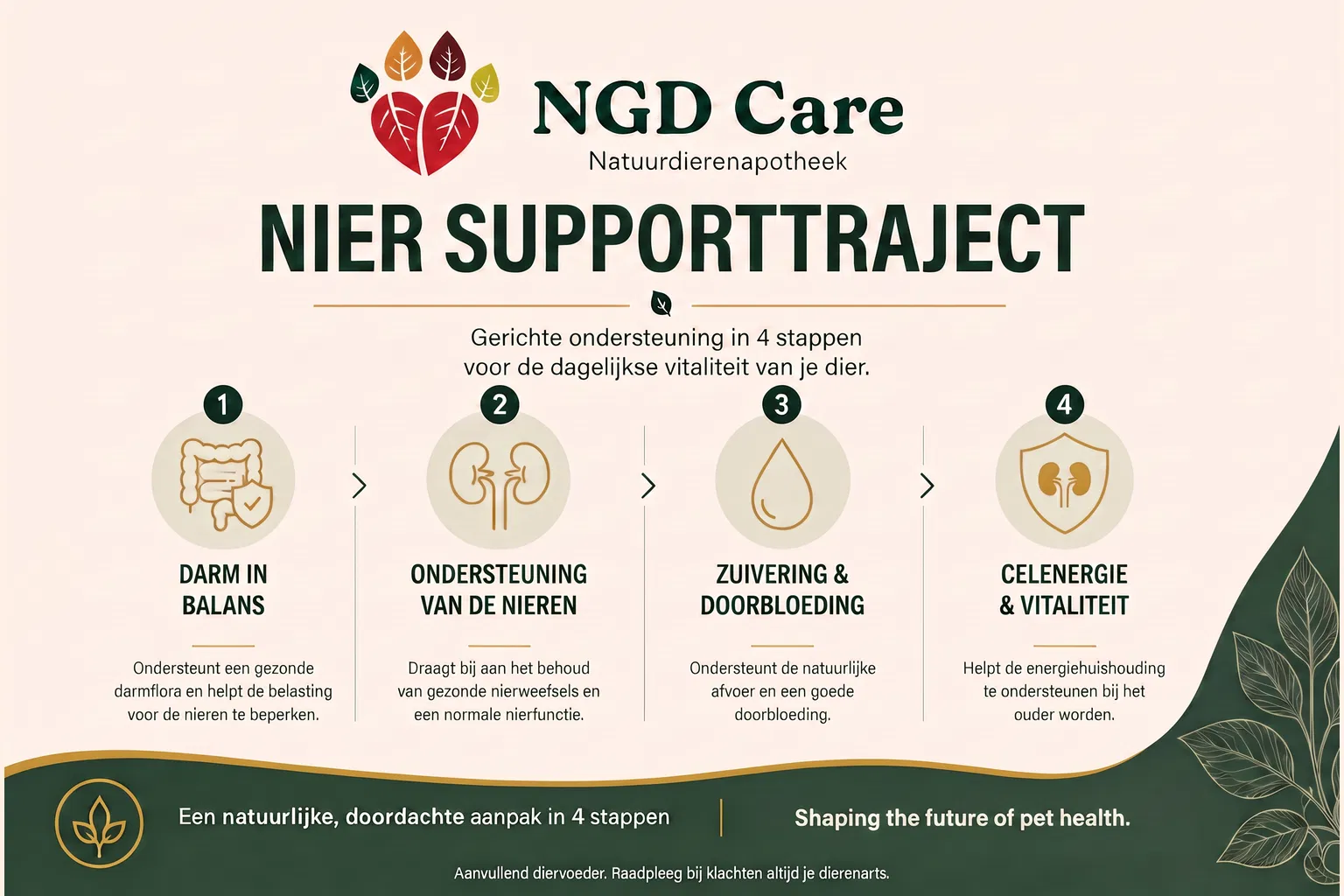
Kidney Support Trajectory
The NGD Care Kidney Support Program is a four-phase supplement schedule for dogs and cats, formulated for the kidneys. Use it in consultation with your veterinarian.
- A four-phase supplement schedule.
- Formulated for the kidneys.
- Does not replace dietetic food, medication, or treatment.
- Use this program in consultation with your veterinarian.
Description
QUICK SUMMARY
The Kidney Support Program is a four-phase supplement schedule for dogs and cats, formulated for the kidneys. Use this program in consultation with your veterinarian.
Why a program and not a separate supplement?
The kidneys filter the blood and actively reabsorb many substances. This requires a lot of energy, which is why renal tubule cells contain many mitochondria.
Gut bacteria also produce substances excreted via the kidneys. Therefore, this program begins with the gut flora. Renal Support, specifically formulated for the kidneys, continues through all four phases. In each phase, supplements are added for the gut, fatty acids, cellular energy, and the antioxidant system.
Four processes in and around the kidneys
The kidneys are much more than a filter. Their function involves blood filtration, reabsorption of useful substances, regulation of fluids and hormones, and the connection to the gut. This program was developed from this systems biology perspective.
Blood is filtered in the renal corpuscles. Water and small substances pass through the filter, while blood cells and large proteins remain.
The kidney reabsorbs useful substances from the filtrate, such as glucose, salts, and water. This requires significant energy, which is why renal tubule cells contain many mitochondria.
The kidneys regulate fluid and salt balance, partly via the renin-angiotensin-aldosterone system (RAAS). They also produce the hormone EPO, which controls red blood cell production, and convert vitamin D into its active form.
Gut bacteria produce substances, such as indoxyl sulfate, that enter the blood and are excreted via the kidneys. These substances are being studied in relation to the kidneys. Therefore, this program begins with the gut flora.
Why this order?
Renal Support is the foundation of all four phases. First, fibers for the gut flora, enzymes, and curcumin are added for the gut-kidney axis. This is followed by mushrooms and omega-3 fatty acids, and in phase 3, substances for mitochondrial energy and the antioxidant system. The maintenance phase maintains a fixed selection for the long term.
How does the Kidney Support Program work?
The program consists of four consecutive phases, with nutrition as the foundation. Each supplement lists its ingredients.
Fresh food contains much more moisture than dry food, and moisture contributes to fluid balance. The amount of protein and phosphorus also varies greatly per diet, and meat with bone contains high levels of phosphorus. Therefore, have the composition tailored to your animal.
Variation in fresh meat as a base: beef, chicken, lamb, game, fish, etc. Preferably raw (BARF, or Biologically Appropriate Raw Food, or KVV). Rotate protein sources regularly.
20% pureed vegetables added to the meal: zucchini, spinach, broccoli, carrot, pumpkin, etc. Pureed and steamed, they are more digestible for dogs and cats.
Is your animal on a prescription diet from the veterinarian? Consult them first before changing the diet.
Want guidance on switching to different food? Schedule an intake with Stefan Veenstra DVM via NatuurlijkGezondeDieren.nl.
The first phase begins with the gut-kidney axis. Gut bacteria produce substances excreted via the kidneys, and the filtration and reabsorption of substances generate free radicals in the kidneys. Renal Support forms the foundation from the start. Renal Support combines cordyceps, astragalus, rehmannia, nettle, curcumin, and coenzyme Q10, and is formulated for the kidneys. Cordyceps, astragalus, and rehmannia have long been used in Chinese tradition and are being studied in cells and laboratory animals. Prebiotic Fibers contains fibers that gut bacteria ferment. The breakdown of protein in the large intestine produces substances such as indole and p-cresol, which are excreted via the kidneys. Fibers shift the gut flora more toward carbohydrate fermentation. Liposomal Curcumin provides extra curcumin on top of the amount in Renal Support. Curcumin is being studied in relation to Nrf2, the switch for the body’s own antioxidant enzymes, which is also active in kidney cells. Biofilm Balance contains enzymes, lactoferrin, and NAC. Bacteria in the gut partly live in a biofilm, a layer they create themselves, and the enzymes are being studied in relation to that layer. NAC is a source of cysteine for glutathione.
In the second phase, mushrooms and fatty acids are added alongside Renal Support. Renal Support continues from phase 1. The plant extracts and mushrooms it contains are given over longer periods in research. Myco Immune Complex contains beta-glucans from four mushrooms. Immune cells recognize beta-glucans via the Dectin-1 receptor, and the kidneys also contain immune cells, such as macrophages. Together with the cordyceps from Renal Support, this forms the mushroom component of the program. Omega 3-Calanus Oil provides EPA and DHA, which are incorporated into cell walls, including those in the kidneys. Enzymes produce different signaling molecules from omega-3 than from omega-6, and these signaling molecules are being studied in relation to renal blood flow.
The third phase focuses on energy in kidney cells and the antioxidant system. Renal tubule cells actively reabsorb many substances from the filtrate and require many mitochondria for this. Renal Support continues from phases 1 and 2. Liposomal Coenzyme Q10 provides extra coenzyme Q10 on top of the amount in Renal Support. It is part of mitochondrial energy production, and the kidneys are among the organs with the highest concentration of coenzyme Q10. Liposomal Glutathione is the most important intracellular antioxidant. The kidneys play a major role in converting glutathione from the blood, and kidney cells use it to neutralize free radicals.
The maintenance phase maintains a fixed foundation for the long term: Renal Support, gut flora, fatty acids, and cellular energy. Renal Support remains the foundation of the program. Prebiotic Fibers continues from phase 1, as gut flora requires fiber as daily nourishment and the gut-kidney axis is a continuous connection. Omega 3-Calanus Oil continues from phase 2, as fatty acids in cell walls are gradually replaced and must be constantly replenished. Longevity Support provides NAD+, a cofactor in energy production also used by sirtuins. Renal tubule cells require high energy levels continuously, and in humans and laboratory animals, NAD+ levels in tissues decline with age.
How do you use the program?
Administer the supplements twice daily for the first 2 months of each phase. Thereafter, administer them once daily. The amount per weight is listed for each supplement. Use this program in consultation with your veterinarian.
Do you have questions during the program, or want to tailor the schedule to your pet? Schedule an intake with integrative veterinarian Stefan Veenstra.
Frequently asked questions
Does this replace dietetic food or medication?
No. This program does not replace dietetic food, medication, or treatment.
Why in consultation with the vet?
Some ingredients may affect the efficacy of medications and are not suitable for every animal.
What is the role of Renal Support?
Renal Support contains astragalus, cordyceps, rehmannia, nettle, curcumin, and coenzyme Q10 and is formulated for the kidneys.
How long does the program take?
The first three phases together last approximately 24 weeks, followed by a maintenance phase.
Why the NGD Care Kidney Support Program?
| Feature | NGD Care |
|---|---|
| Composition | A schedule with NGD Care supplements, in a fixed order. |
| Human grade | We use human-grade ingredients. |
| Individual guidance | Would you like personal advice for your animal? This is possible via a consultation with Stefan Veenstra. |
Scientific literature
- Bentinger M, et al. (2010). Coenzyme Q: biosynthesis and functions. Biochemical and Biophysical Research Communications.
- Fu J, et al. (2014). Review of the botanical characteristics, phytochemistry, and pharmacology of Astragalus membranaceus (Huangqi). Phytotherapy Research.
- Zhang RX, et al. (2008). Rehmannia glutinosa: review of botany, chemistry and pharmacology. Journal of Ethnopharmacology.
Want to read more about nutrients and body processes?
In the knowledge base, you’ll find background articles about nutrition and how the body works. Have a question about this program or want personal advice? Feel free to contact us.
Developed by Stefan Veenstra DVM, integrative veterinarian. Stefan is the founder of NGD Care, NGD Care Academy and Integrative Veterinary Center Natural Healthy Animals. Read more about Stefan →
This information is educational in nature and does not replace a veterinary consultation. In case of severe or persistent complaints, always consult a veterinarian.
Ingredients, dosage and use
- Ingredients can be found under the individual products
- For the first 2 months of each phase, we recommend a therapeutic dosage of twice daily. Afterwards, you can switch to a maintenance dosage of once daily.
- Therapeutic dosage
- For a maximum of 8 weeks on the advice of a veterinarian or therapist
- <10kg 2xdaily 1/2 capsule
- 10-30kg 1 capsule 2xdaily
- >30kg 2x daily 2 capsules
- Maintenance Dosing
- <10kg 1x daily 1/2 capsule
- 10-30kg 1x daily 1 capsule
- >30kg 2 capsules 1x day
- This means that for a dog weighing 10 to 30 kg, you must select the product twice for each phase to provide the correct dosage for 8 weeks.
Disclaimer
- This product is a dietary supplement and not a substitute for a healthy lifestyle and varied balanced diet.
- The products are not medicines and cannot be used as medicines, but as a dietary supplement. In case of illness or other medical condition, always consult a veterinarian before use.
- Dietary supplements may have interactions and side effects with regular medications.
- Keep out of reach of young children.
- Consult an expert before using supplements in case of pregnancy, lactation, medication use and illness.