

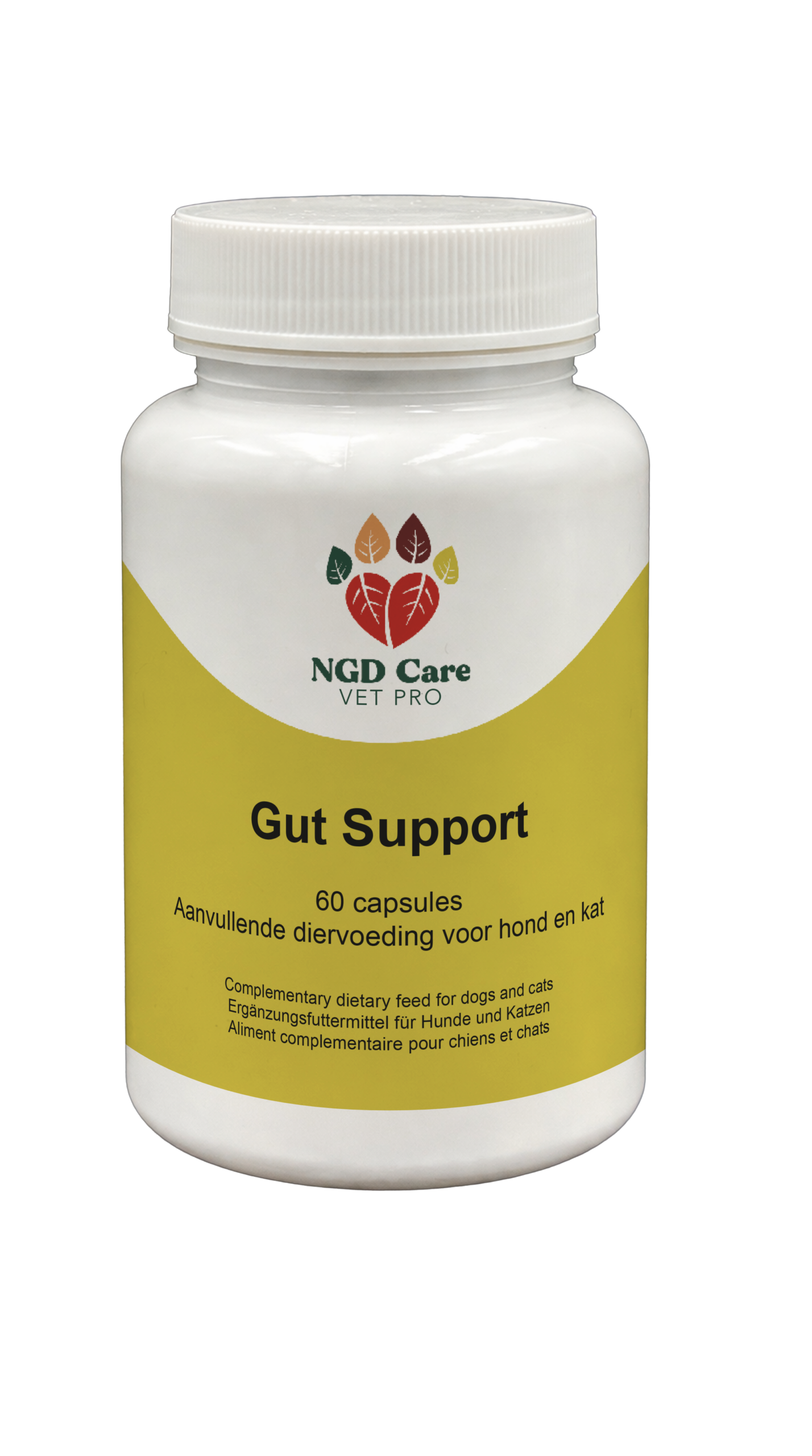
Gut Support
€ 49,95
NGD Care Gut Support is a complementary feed for dogs and cats with Saccharomyces boulardii, Lactobacillus rhamnosus GG, L-glutamine, pectin, and zinc carnosine. This combination is formulated for a balanced intestinal flora and normal bowel function.
- Contains two microorganisms: a yeast and a lactic acid bacterium.
- Supplemented with L-glutamine, pectin, and zinc carnosine.
- Each capsule contains 2.5 billion CFU.
- You can also open the capsule and mix it with food.
Description
QUICK SUMMARY
Gut Support is a complementary feed for dogs and cats with two microorganisms, L-glutamine, pectin, and zinc carnosine. Gut Support is formulated for a balanced intestinal flora and normal bowel function.
What’s in this supplement?
Each capsule contains 2 billion CFU Saccharomyces boulardii, 0.5 billion CFU Lactobacillus rhamnosus GG, 250 mg L-glutamine, 150 mg pectin, and 17.5 mg zinc carnosine. CFU stands for colony-forming units, the measure for the number of living microorganisms.
What does Gut Support do?
Gut Support is formulated for a balanced intestinal flora and normal bowel function. The ingredients complement each other: the yeast and the bacterium are living microorganisms, pectin is food for the bacteria already living in the gut, and L-glutamine and zinc are used by the cells of the intestinal wall itself.
The biochemistry per ingredient
Saccharomyces boulardii
Saccharomyces boulardii is a yeast, which is a small single-celled organism and not a bacterium. A yeast is structured differently than a bacterium. As a result, antibiotics, which target bacteria, do not affect this yeast. Antifungal agents do affect it.
The yeast does not stay in the gut. It travels with the intestinal contents and leaves the body with the stools, usually within a few days after you stop using it. Along the way, it releases substances such as polyamines. These are small molecules that cells use for growth and renewal.
Lactobacillus rhamnosus GG
This is a lactic acid bacterium. GG is the name of this specific strain, and properties apply per strain. Another L. rhamnosus is therefore not the same.
The bacterium converts sugars into lactic acid, making the environment slightly more acidic. On its surface are hair-like protrusions called pili. These allow it to attach to the mucus layer on the intestinal wall. It stays there for a while and then disappears again.
L-glutamine
Glutamine is an amino acid, a building block of protein, and it is common in the blood. The body also produces it itself. The cells of the intestinal wall use glutamine as fuel. Those cells only live for a few days and are constantly replaced, which requires a lot of energy.
The intestinal cells are attached to each other with tight junctions, which you can think of as zippers between the cells. Research with intestinal cells shows that glutamine plays a role in building these zippers.
Pectin
Pectin is a fiber from the cell walls of fruit, and you know it as the gelling agent in jam. With water, pectin forms a soft gel. This gel makes the intestinal contents a bit thicker and ensures they pass more slowly. That is why you give medications separately from this supplement.
Dogs and cats cannot digest pectin themselves, but the bacteria in the large intestine can. They turn it into short-chain fatty acids, such as butyric acid. The cells of the large intestine use butyric acid as an important fuel.
Zinc carnosine
This is zinc attached to carnosine, a small molecule of the amino acids alanine and histidine. Research on the stomach wall describes that this compound can attach to proteins. When absorbed in the intestine, it breaks down into zinc and carnosine, according to research in rats.
Zinc is needed for many enzymes and for cell division. This fits the intestinal wall, where new cells are constantly being made.
How strong is this evidence? The properties of these strains and substances are well-documented. Most research has been conducted in humans, in cell tests, and in laboratory animals. Little research has been done with this combination in dogs and cats.
Safety
Is your pet lethargic, not drinking, vomiting repeatedly, or do you see blood in the stools? Then go to the vet immediately. Young animals can dehydrate quickly. This supplement is not intended for this.
Frequently asked questions
My pet is taking antibiotics. When do I give Gut Support?
Give Gut Support at least 2 hours after antibiotics and consult your veterinarian about this. Other points of attention regarding medication can be found under Dosage and use.
Is Gut Support suitable for puppies and kittens?
Gut Support can be given in the amount that fits the weight. If a young animal is unwell, have it assessed by a veterinarian first.
What is the difference with Prebiotic Fibers?
Gut Support contains living microorganisms and building blocks. Prebiotic Fibers contains fibers that serve as food for gut bacteria.
Why NGD Care Gut Support?
| Feature | NGD Care |
|---|---|
| Form of administration | A capsule that you can give whole or open and mix with food. |
| Human grade | We use human-grade ingredients. |
| Clean and green label | The capsule is free from synthetic additives. |
| Individual guidance | Would you like personal advice for your animal? This is possible via a consultation with Stefan Veenstra. |
Works well with
Prebiotic fibers serve as food for gut bacteria. Gut bacteria produce short-chain fatty acids from them.
Stomach Support is formulated for the stomach and Gut Support for the gut. This way, the two products follow the digestive tract.
This product contains only L-glutamine, for those who want to give more of this amino acid than is in Gut Support.
Scientific literature
- Pais P, et al. (2020). Saccharomyces boulardii: what makes it tick as successful probiotic? Journal of Fungi.
- Segers ME, Lebeer S. (2014). Towards a better understanding of Lactobacillus rhamnosus GG – host interactions. Microbial Cell Factories.
- Rao R, Samak G. (2012). Role of glutamine in protection of intestinal epithelial tight junctions. Journal of Epithelial Biology and Pharmacology.
- Elshahed MS, et al. (2021). Pectin in diet: interactions with the human microbiome, role in gut homeostasis, and nutrient-drug interactions. Carbohydrate Polymers.
Want to read more about nutrients and body processes?
In the knowledge base, you’ll find background articles on nutrition and how the body works. Do you have a question about this supplement or would you like personal advice? Please feel free to contact us.
Developed by Stefan Veenstra DVM, integrative veterinarian. Stefan is the founder of NGD Care, NGD Care Academy and Integrative Veterinary Center Natural Healthy Animals. Read more about Stefan →
This information is educational in nature and does not replace a veterinary consultation. In case of severe or persistent complaints, always consult a veterinarian.
Ingredients
- Ingredients
- S.boulardii, L.rhamnosus, L-glutamine, pectin, zinc
- Composition per capsule
- 2 billion CFU Saccharomyces boulardii
- 0.5 billion CFU Lactobacillus rhamnosus GG
- 250mg L-glutamine
- 150mg Pectin
- 17.5mg Zinc Carnosine
Dosage and use
- Dosage dog and cat
- Starting dose 2x daily, maintenance dose 1x daily 1 capsule per 10 kg.
Body weight Capsules per dose Up to 5 kg ½ capsule 5 to 15 kg 1 capsule 15 to 25 kg 2 capsules 25 to 35 kg 3 capsules 35 to 45 kg 4 capsules
- Starting dose 2x daily, maintenance dose 1x daily 1 capsule per 10 kg.
- Manual
- Capsule can be given whole or opened and mixed with food.
- Contraindications
- Severe liver disease with hepatic encephalopathy: L-glutamine can contribute to ammonia formation. Use only in consultation with a veterinarian.
- Side effects
- Possible increased flatulence or bloating during the first few days.
- Interactions
- Antifungal medications (fluconazole, itraconazole, nystatin) inhibit S. boulardii. Administer at least 3 hours apart; the effectiveness of Gut Support may be reduced.
- Antibiotics: inhibit L.rhamnosus. Administer Gut Support 2 hours after antibiotics.
- Tetracyclines and fluoroquinolones (such as doxycycline, enrofloxacine): zinc may reduce absorption. Administer at least 2 hours apart.
- Other medication: pectin may delay absorption. Administer at least 2 hours apart.
Disclaimer
- This product is a dietary supplement and not a substitute for a healthy lifestyle and varied balanced diet.
- The products are not medicines and cannot be used as medicines, but as a dietary supplement. In case of illness or other medical condition, always consult a veterinarian before use.
- Dietary supplements may have interactions and side effects with regular medications.
- Keep out of reach of young children.
- Consult an expert before using supplements in case of pregnancy, lactation, medication use and illness.