

Liver Support
€ 44,95
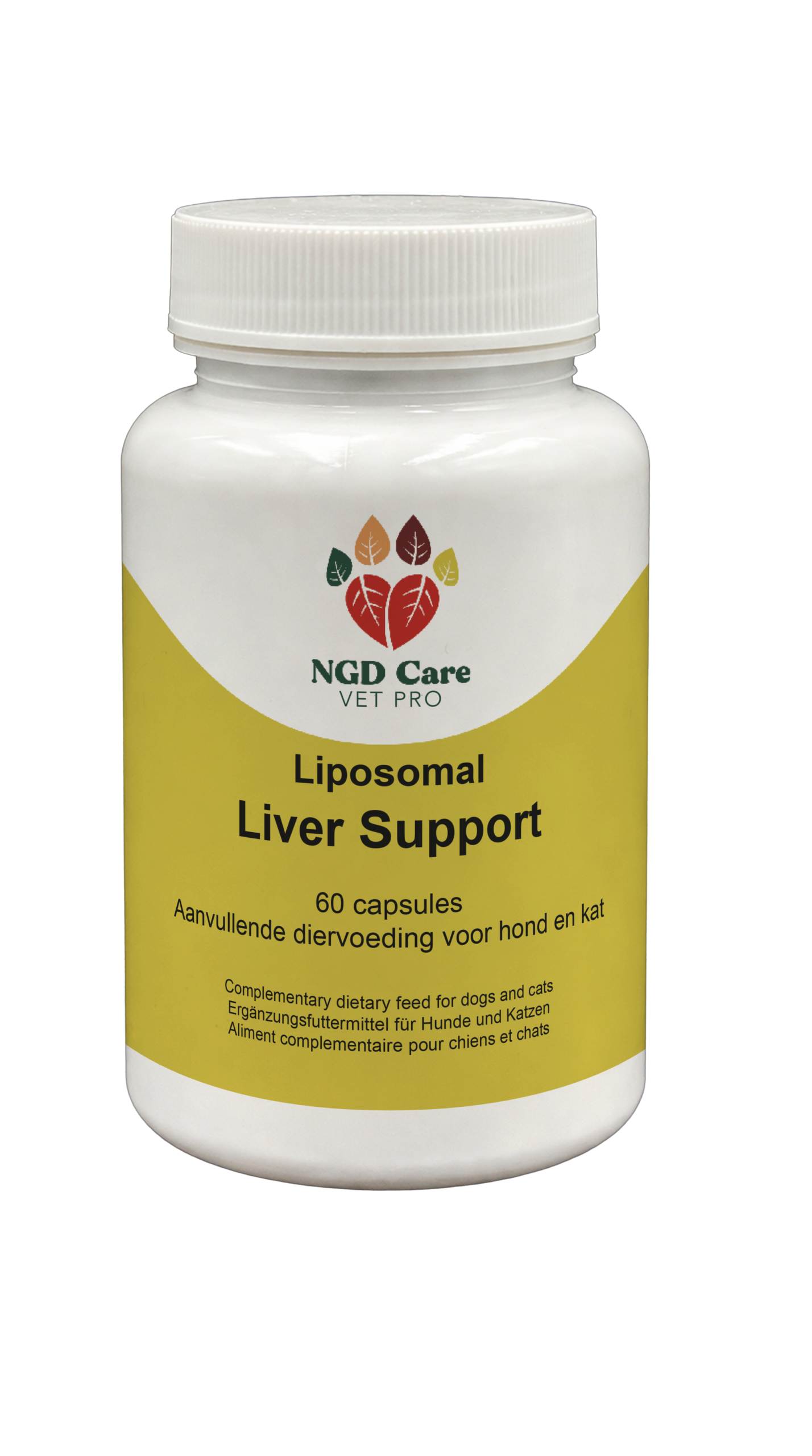
NGD Care Liver Support is a complementary feed for dogs and cats with NAC, phytosomal silymarin, artichoke extract, SAMe, liposomal curcumin, and dandelion extract. Liver Support is formulated for the liver. Use it in consultation with your vet.
- Contains NAC, silymarin, SAMe, artichoke, dandelion, and curcumin.
- Silymarin is phytosomal and curcumin is liposomal.
- You can also open the capsule and mix it with food.
- Use Liver Support in consultation with your vet.
Description
QUICK SUMMARY
Liver Support is a complementary feed for dogs and cats with NAC, silymarin, artichoke, SAMe, curcumin, and dandelion. Liver Support is formulated for the liver. Use it in consultation with your vet.
What’s in this supplement?
Each capsule contains 100 mg N-acetylcysteine (NAC), 75 mg phytosomal silymarin, 50 mg artichoke extract, 50 mg SAMe (tosylate salt), 37.5 mg liposomal curcumin, and 37.5 mg dandelion extract.
What does Liver Support do?
Liver Support combines sources of building blocks for glutathione with plant extracts traditionally associated with the liver. The ingredients are chosen for the liver, and use should be in consultation with your vet.
The biochemistry per ingredient
NAC
NAC stands for N-acetylcysteine and is a source of cysteine. The cell creates glutathione from three building blocks, and cysteine is usually the building block that runs out first.
SAMe
SAMe (S-adenosylmethionine) is the main supplier of methyl groups in the body. These are small groups that are linked to other substances to change them. The further conversion of SAMe also produces cysteine.
Silymarin
Silymarin comes from the seeds of the milk thistle and is a mixture of plant substances, with silybin being the most important. Phytosomal means it is attached to fatty substances to support absorption.
Artichoke and dandelion
Artichoke contains caffeoylquinic acids such as cynarin, and dandelion contains bitter substances, among others. Both belong to the Asteraceae family (composites), just like milk thistle. Therefore, this product is not suitable for those with an allergy to composites.
Curcumin
Curcumin is the yellow pigment from turmeric. It dissolves poorly in water, which is why it is included here in a liposomal form.
How strong is this evidence? The metabolism of glutathione and SAMe is well-established. Data on the plant extracts come mainly from cell and animal trials and human studies. Little research has been done with this combination in dogs and cats.
Frequently asked questions
Why in consultation with the vet?
The ingredients can influence the effect of some medications and are not suitable for every animal. The ‘Dosage and use’ section states when you should not give this product.
What is the difference with Liposomal Glutathione?
Liposomal Glutathione contains the tripeptide itself. Liver Support contains NAC and SAMe, among others, which are sources of building blocks for glutathione.
My animal is allergic to composites. Can I use Liver Support?
No. Artichoke, dandelion, and milk thistle belong to the Asteraceae (composite) family.
Why NGD Care Liver Support?
| Feature | NGD Care |
|---|---|
| Form of administration | A capsule that you can give whole or open and mix with food. |
| Human grade | We use human-grade ingredients. |
| Clean and green label | The capsule is free from synthetic additives. |
| Individual guidance | Would you like personal advice for your animal? This is possible via a consultation with Stefan Veenstra. |
Works well with
NAC and SAMe provide building blocks for glutathione. Liposomal Glutathione contains the tripeptide itself.
Blood from the intestines enters the liver via the portal vein. Gut Support is formulated for a balanced intestinal flora.
Glutathione can return oxidized vitamin C to its active form.
The liver and kidneys both play a role in processing and removing substances.
Part of a protocol
Liver Support is part of the Liver Support Protocol. A protocol is a schedule in which multiple supplements are given in a fixed order. This protocol is intended for use in consultation with your vet.
Scientific literature
- Lu SC. (2013). Glutathione synthesis. Biochimica et Biophysica Acta.
- Aldini G, et al. (2018). N-Acetylcysteine as an antioxidant and disulphide breaking agent: the reasons why. Free Radical Research.
- Bijak M. (2017). Silybin, a major bioactive component of milk thistle (Silybum marianum L. Gaernt.): chemistry, bioavailability, and metabolism. Molecules.
- Lattanzio V, et al. (2009). Globe artichoke: a functional food and source of nutraceutical ingredients. Journal of Functional Foods.
- González-Castejón M, et al. (2012). Diverse biological activities of dandelion. Nutrition Reviews.
Want to read more about nutrients and body processes?
In the knowledge base, you’ll find background articles on nutrition and how the body works. Do you have a question about this supplement or would you like personal advice? Please feel free to contact us.
Developed by Stefan Veenstra DVM, integrative veterinarian. Stefan is the founder of NGD Care, NGD Care Academy and Integrative Veterinary Center Natural Healthy Animals. Read more about Stefan →
This information is educational in nature and does not replace a veterinary consultation. In case of severe or persistent complaints, always consult a veterinarian.
Ingredients
- Ingredients
- NAC, silymarin, artichoke, SAMe, curcumin, dandelion
- Composition per capsule
- 100 mg NAC
- 75 mg phytosomal silymarin
- 50 mg artichoke extract
- 50 mg SAMe (tosylate salt)
- 37.50 mg liposomal curcumin
- 37.50 dandelion extract
Dosage and use
- Dosage dog and cat
- Starting dose 2x daily, maintenance dose 1x daily 1 capsule per 10 kg.
Body weight Capsules per dose Up to 5 kg ½ capsule 5 to 15 kg 1 capsule 15 to 25 kg 2 capsules 25 to 35 kg 3 capsules 35 to 45 kg 4 capsules
- Starting dose 2x daily, maintenance dose 1x daily 1 capsule per 10 kg.
- Manual
- Capsule can be given whole or opened and mixed with food.
- Contraindications
- Bile duct obstruction or gallstones: artichoke, dandelion, and curcumin stimulate bile drainage.
- Allergy to composites (Asteraceae): artichoke, dandelion, and milk thistle belong to this family.
- Jaundice, acute liver failure, or hepatic encephalopathy: only under the guidance of a veterinarian.
- Side effects
- Sometimes nausea or vomiting, especially due to SAMe and NAC. If so, give with a small amount of food. Artichoke and dandelion can make stools slightly softer.
- Interactions
- Serotonergic medication (clomipramine, fluoxetine, selegiline, tramadol): SAMe increases serotonin activity, with a risk of serotonin syndrome. Only in consultation with the veterinarian.
- Medication with a narrow therapeutic range metabolized by the liver: silymarin and curcumin slightly inhibit some CYP enzymes. Consult with the veterinarian.
- Blood thinners and NSAIDs: curcumin can theoretically increase bleeding tendency. Only in consultation with the veterinarian.
- Diuretics: dandelion has a mild diuretic effect and may enhance the effect.
- Insulin: silymarin and curcumin can slightly lower blood sugar. Monitor glucose in diabetic animals.
Disclaimer
- This product is a dietary supplement and not a substitute for a healthy lifestyle and varied balanced diet.
- The products are not medicines and cannot be used as medicines, but as a dietary supplement. In case of illness or other medical condition, always consult a veterinarian before use.
- Dietary supplements may have interactions and side effects with regular medications.
- Keep out of reach of young children.
- Consult an expert before using supplements in case of pregnancy, lactation, medication use and illness.