


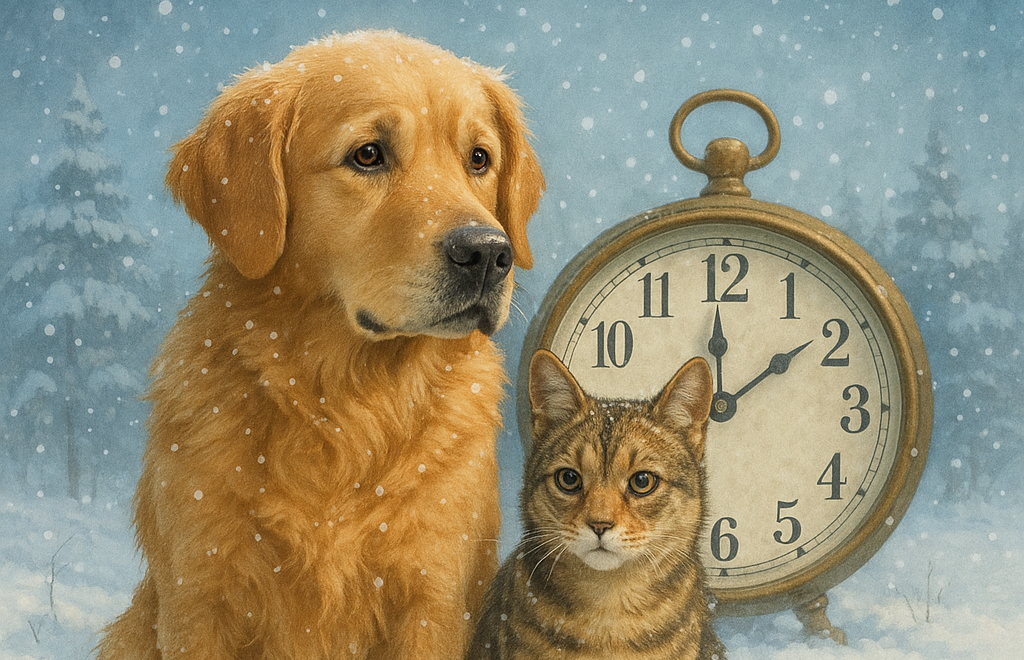
The transition from summer time to winter time seems to us to be only one hour.
But especially for animals, it means that their entire day and night rhythm shifts.
Read along for the tips, which you can also apply to yourself.
The biological clock – controlled by light, temperature and day length – determines much more than just sleep.
It affects:
appetite
Hormone production
digestion
mood and stress processing
the immune system
Due to the abrupt shift of one hour, the control center in the hypothalamus becomes temporarily unbalanced. This makes many animals temporarily more sensitive to stress, sleeping problems, behavioral changes and physical complaints.
Without clock change, the body would gradually adapt to the shorter days of autumn and winter. By suddenly moving the natural transition is disrupted.
What many owners notice around winter time
Many dogs and cats are treated during this period:
more restless or sluggish
hungry at ‘wrong’ times
less able to fall asleep or stay asleep
more sensitive to stress or separation anxiety
more irritable during walks
more likely to suffer from skin or intestinal complaints
These are complaints that occur more often in autumn anyway – but winter time can reinforce and accelerate this.
Why does this happen?
1. Less daylight = different hormone balance
In the autumn, the day length decreases rapidly.
This ensures:
less serotonin (mood, rest, appetite)
more melatonin (sleep, recovery, sluggishness)
This hormonal shift can cause behavioral changes, sleep problems, and a lower stress threshold.
Sensitive or fearful animals react most strongly to this.
2. The microbiome changes with the season
Research shows that the microbiome of animals fluctuates seasonally .
Less exercise, more sitting indoors, cold and less light:
reduce the diversity of the microbiome
lower the immune system
can trigger diarrhea/stress-sensitive intestines
Amplify skin problems and itching
3. The transition to colder weather puts extra strain on the body
This should certainly not be missed, because many owners notice it every year:
Cold weather causes additional complaints:
more stiff joints
increased itching, dry fur or flakes
increased airway sensitivity
more recurrent ear or skin infections
more abdominal complaints or flatulence
more tension or stimulus-sensitive behavior
The combination of winter time + cold + less light causes a temporary dip in resistance.
Both the immune system and the barrier functions of the skin, intestine and respiratory tract are under pressure during this period.
What can you do to support your animal well?
1. Restoring plenty of daylight and rhythm
Walk in the morning when it is already light: this resynchronizes the biological clock.
Maintain fixed eating and sleeping times.
Change times in small increments (10–15 minutes per day) whenever possible.
Avoid too much blue light in the evening if your animal sleeps in the same room; This can inhibit melatonin.
2. Adapt nutrition and supplements to the season
Nutrition:
Choose warmer, easily digestible meals (such as steamed meat, pumpkin, carrot).
Add seasonal vegetables.
Avoid cold food for sensitive intestines during this period.
Natural supplements that are now extra valuable
✔ Lactoferrin (NGD Care) – resistance & intestines
supports the immune system
Protects against low-grade inflammation
supports the intestinal barrier
helps with seasonal abdominal complaints
✔ Mushroom mix 1 – immune & allergies
rich in beta-glucans
Enhances immune response without overactivation
supports chronic complaints such as itching, allergies & tumors
✔ Omega-3 (Calanus Oil)
Supports skin, coat & mood
has an anti-inflammatory effect
ideal for joint stiffness due to cold
✔ Probiotics / Prebiotics
strengthen the microbiome
improve bowel movements, stress resistance and immune function
✔ Adaptogens in stress-sensitive animals (Ashwagandha/Rhodiola, Mushroom mix 2, CBD oil)
support stress regulation
help with restlessness due to hormonal fluctuations and less light
👉 Go directly to these products
When to use protocols?
Recurring complaints due to winter time + colder periods (such as diarrhea, itching, stress, ear problems) almost always involve an underlying chronic imbalance.
Then a protocol is often more effective:
Intestinal protocol (for intestines, allergies, resistance, stress) 👉 Go directly to this product
Stress protocol (for separation anxiety, sensitivity to stimuli, winter blues) 👉 Go directly to this product
Skin protocol (for itching, hot spots, allergies) 👉 Go directly to this product
These really help to restore the system structurally – not just symptom control.
3. Provide warmth, peace and security
According to Chinese medicine, winter falls under the Water element:
a phase of slowing down, saving inner peace and energy.
What helps:
A warm, quiet place
Regular moments of rest
Fewer stimuli on days with low light
aromatherapy (such as Grounding Support) to Ground 👉 Here you can find the Grounding Support
a chakra blossom for balance (such as Inner Alignment Essence) 👉 Here you can find the Inner Alignment Essence
This helps body and mind to make the transition to winter smooth.
Summary
The transition to winter time and cold is a vulnerable period for many animals.
Their biological clock, immune system and microbiome have to reset.
With:
Good daylight
warm and regular rhythm
Seasonal diet
natural support (such as lactoferrin, mushroom mix 1, omega-3, probiotics)
peace and security
your dog or cat stays in balance – physically and mentally.


