

Heart Support Trajectory
€ 77,90
Additional supplementation support for MVD, DCM, HCM and cardiac arrhythmias in dogs and cats. Targeting CoQ10 repair, myocardial fibrosis, gut-heart axis, and diuretic cofactor losses.
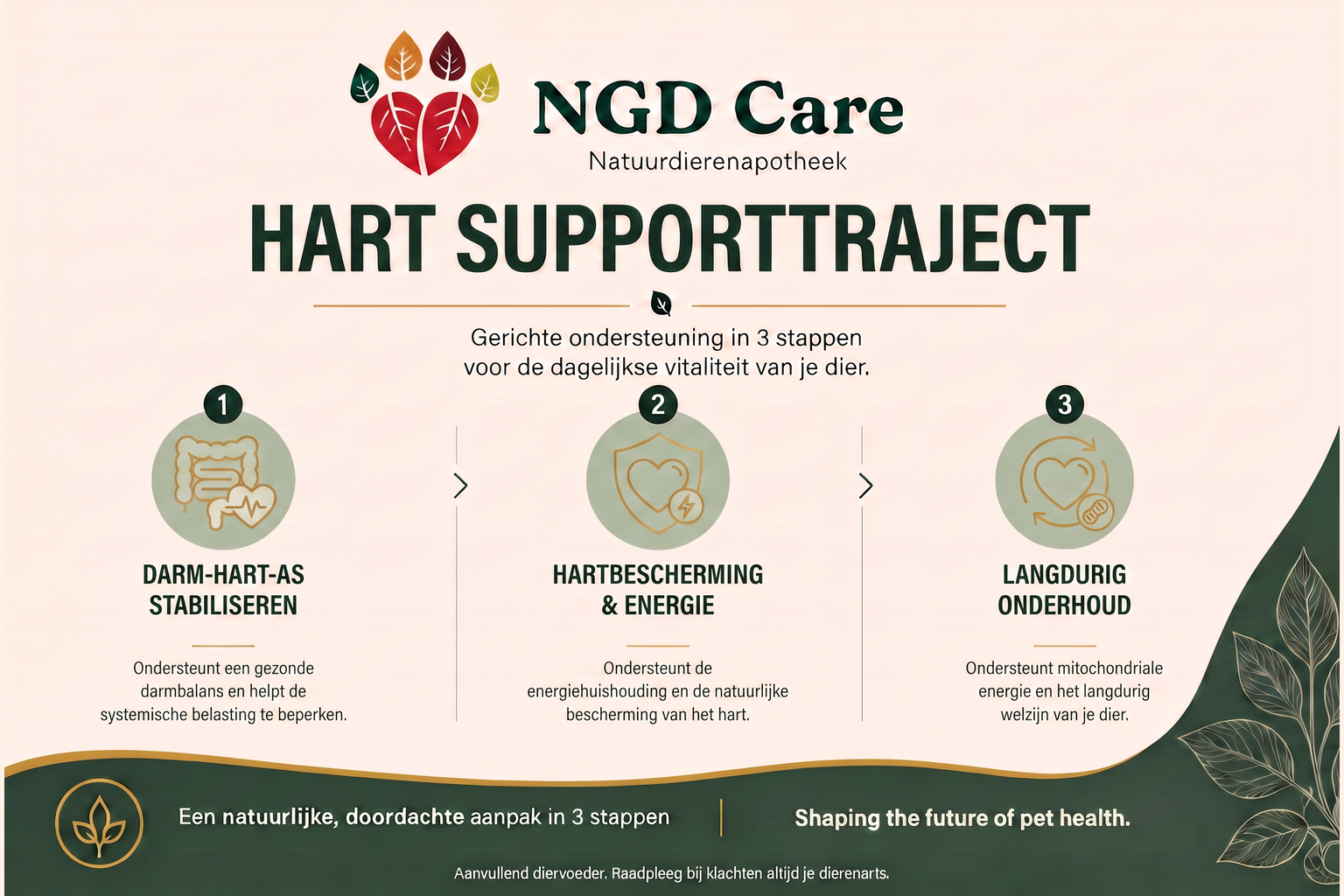
- Three phases: stabilizing the gut-heart axis, myocardial protection via CoQ10 and anti-fibrosis, mitochondrial maintenance
- Liposomal CoQ10 as a core: the heart has the highest energy requirements of any organ
- Relax Support (magnesium) for antiarrhythmic action and supplementation for furosemide excretion
- Omega-3 for Cardiac Electrophysiology, Fibrosis Inhibition and TMAO Lowering
- Liposomal Vitamin B Complex for Thiamine Supplementation in Diuretic Use
Description
Your animal has received a heart diagnosis: mitral valve degeneration, dilating cardiomyopathy, heart failure or a heart rhythm disorder. Or the vet has found a heart murmur during a routine check-up. The NGD Care Heart Support Bundle has been developed as an addition to your veterinarian’s treatment. We explain what is really going on in the heart of your animal, what the medication does and what we recommend to protect the myocardium and slow down its progression.
What your vet told you, and what else is going on
Your veterinarian has diagnosed a heart defect and may prescribe medication: pimobendan, furosemide, benazepril or spironolactone. This medication is necessary for symptomatic heart failure and prolongs life. But in an average consultation, there is no room to explain why heart disease is so much more than a pumping problem, and how the biological environment around the heart makes the difference between slow and fast progression.
What your vet may not have explained
Nutrition for heart disease: what we recommend
In heart disease, a low-sodium diet is recommended to limit fluid retention. This is justified in symptomatic heart failure. But the nutritional quality itself rarely gets attention.
Our nutritional advice for heart disease
Four mechanisms that drive heart disease
The heart is the most energy-consuming organ. In heart failure, CoQ10 status decreases and mitochondrial efficiency deteriorates, which lowers contractility and accelerates progression.
RAAS activation and sympathetic overactivation compensate for reduced cardiac flow but increase afterload and promote myocardial fibrosis and hypertrophy in the long term.
TGF-β1 activates cardiac fibroblasts that produce collagen in the myocardium. Fibrosis lowers the compliancy of the heart and worsens diastolic dysfunction.
TMAO from dysbiosis damages the vascular endothelium and promotes atherosclerosis. LPS via leaky gut enhances myocardial inflammation via TLR4 activation.
Our advice: phased support in addition to your vet’s medication
The phasing follows the mechanistic priorities: first stabilize gut and systemic inflammation, then protect the heart directly via CoQ10 and anti-fibrosis, then mitochondrial and neuro-hormonal maintenance. Always inform the treating veterinarian about supplementation in case of active medication use.
LPS through a disrupted intestinal barrier activates TLR4 on cardiomyocytes and macrophages in the myocardium, which induces NF-kB activation and potentiates myocardial inflammation and fibrosis. Biofilm Balance targets the underlying dysbiosis, Prebiotics reduce the LPS-producing dysbiosis and increase TMAO-lowering sacharolytic bacteria. Liposomal Curcumin inhibits NF-kB and TGF-β1 in cardiomyocytes. Vitamin C is a cofactor for collagen-III synthesis in the vessel wall and protects the vascular endothelium.
Liposomal CoQ10 is the core of phase 2. The heart consumes more energy per gram than any other organ and is completely dependent on adequate CoQ10 availability for the electron transport chain. In heart failure and when using statins, CoQ10 is structurally reduced. Omega Blend modulates prostaglandin balance, lowers heart rate variability, and inhibits TGF-β1-mediated fibrosis in the myocardium. Relax Support provides magnesium as a cofactor for sodium pump, calcium channel regulation, and more than 300 enzymatic reactions, many of which are directly relevant to cardiac electrophysiology. Magnesium excretion is increased with furosemide use. PEA Complex stabilizes mast cells and supports the nervous system, relevant in the low-grade systemic inflammation that accompanies heart disease.
Longevity Support restores through NAD⁺ the sirtuin activity that regulates mitochondrial biogenesis in cardiomyocytes. SIRT3 is specifically active in cardiomyocyte mitochondria and protects against oxidative stress-induced apoptosis. Resveratrol activates SIRT1 with additional anti-fibrotic action. Liposomal Vitamin B-Complex supplements the B vitamins that are excreted at an accelerated rate during furosemide and other diuretic use. B1 (thiamine) is specifically essential for cardiac energy production. Thiamine deficiency is associated with cardiomyopathy. Liposomal CoQ10 and Omega Blend will continue in this phase, supplemented with Liposomal Glutathione for broader antioxidant protection.
What can you expect and when?
Heart disease is chronic and progressive. The bundle focuses on slowing down progression and improving quality of life. Steer on the ultrasound cardiography parameters that the veterinarian measures, especially left atrium/aortic ratio and left ventricular end-diastolic volume.
Intestine stabilized. Systemic LPS burden on the myocardium reduced. Less shortness of breath during exertion may be noticeable.
CoQ10 restored. Better cardiac energy production. More load capacity and less fatigue visible.
Mitochondrial recovery consolidated. More stable heart function at ultrasound check. Better quality of life.
Long-term maintenance. Progression slowed. Medication needs may be more stable in consultation with the vet.
Always inform the treating veterinarian about supplementation with heart medication. CoQ10 may affect cardiac sensitivity when used in pimobendan. Magnesium may be relevant when combined with certain antiarrhythmic drugs. Always adjust in consultation.
Specific points of attention for each condition
Most common heart disease in dogs. Cavalier King Charles Spaniel, Chihuahua, and Dachshund are risk-breeds. Stage B1-B2: full beam insertion for progression inhibition. Stage C-D: supplemental to pimobendan and furosemide.
Doberman, Great Dane, Boxer. Taurine and L-carnitine deficiency as a diet-related cause in a grain-free diet. Fresh meat nutrition including heart and liver as a direct source of taurine is the first step. Taurine and L-carnitine will soon be available through the NGD Care Vet Pro Line as a targeted heart formula.
Most common heart disease in cats. Maine Coon and Ragdoll genetically predisposed. Focus on fibrosis inhibition via curcumin, oxidative protection via CoQ10 and glutathione. Tachycardia management via omega-3 and magnesium.
Magnesium is the most underestimated antiarrhythmic intervention. It stabilizes the electrical potential of cardiomyocytes via calcium channel blocker. In the case of furosemide, magnesium supplementation is almost always indicated. Omega-3 lowers ventricular arrhythmia risk via membrane stabilization.
For which situations do we recommend this bundle?
Frequently Asked Questions (FAQ)
Is CoQ10 safe to combine with pimobendan or other heart medications?
CoQ10, omega-3 and magnesium are widely used in addition to regular heart medication. Always discuss supplementation with the treating veterinarian, especially when used in combination with pimobendan, diuretics or antiarrhythmics, so that dosages remain aligned.
How long does it take to see results?
The first effects, such as less shortness of breath and more energy, are often noticeable from weeks 6 to 14, when the CoQ10 status is restored. Structural improvement of heart function on ultrasound control usually takes 4 to 6 months.
Can this bundle replace my vet’s heart medication?
No. The Heart Support Bundle is an addition to the vet’s treatment, not a replacement. In symptomatic heart failure, medication such as pimobendan or furosemide is necessary and life-prolonging.
Is this bundle suitable for cats with HCM?
Yes, in hypertrophic cardiomyopathy (HCM) in cats, the focus is on phases 2 and 3: fibrosis inhibition via curcumin, oxidative protection via CoQ10 and glutathione, and tachycardia management via omega-3 and magnesium.
Want to read the full scientific background?
Stefan Veenstra DVM explains how RAAS, myocardial fibrosis, CoQ10 deficiency and the gut-heart axis are related to heart disease in dogs and cats.
All supplements in this bundle
Developed and clinically substantiated by Stefan Veenstra DVM, integrative veterinarian and founder of NGD Care and Naturally Healthy Animals. For personal guidance: NGD Care consultation →
This bundle is educational in nature and does not replace a veterinary consultation. The Heart Support Bundle is intended as a supplement to regular veterinary treatment, never as a replacement. Always inform the attending veterinarian about the supplementation in case of active use of heart medication.
Ingredients, dosage and use
- See the individual ingredients
- For the first month, we recommend a double therapeutic dose of 2x daily. Then a maintenance dose of 1x daily.
- Each phase is suitable for a treatment of 2-4 months for a dog or cat <10kg and for 1-2 months for a dog of 10-30kg.
Disclaimer
- This product is a dietary supplement and not a substitute for a healthy lifestyle and varied balanced diet.
- The products are not medicines and cannot be used as medicines, but as a dietary supplement. In case of illness or other medical condition, always consult a veterinarian before use.
- Dietary supplements may have interactions and side effects with regular medications.
- Keep out of reach of young children.
- Consult an expert before using supplements in case of pregnancy, lactation, medication use and illness.