

Metabolic Balance Trajectory
€ 122,85
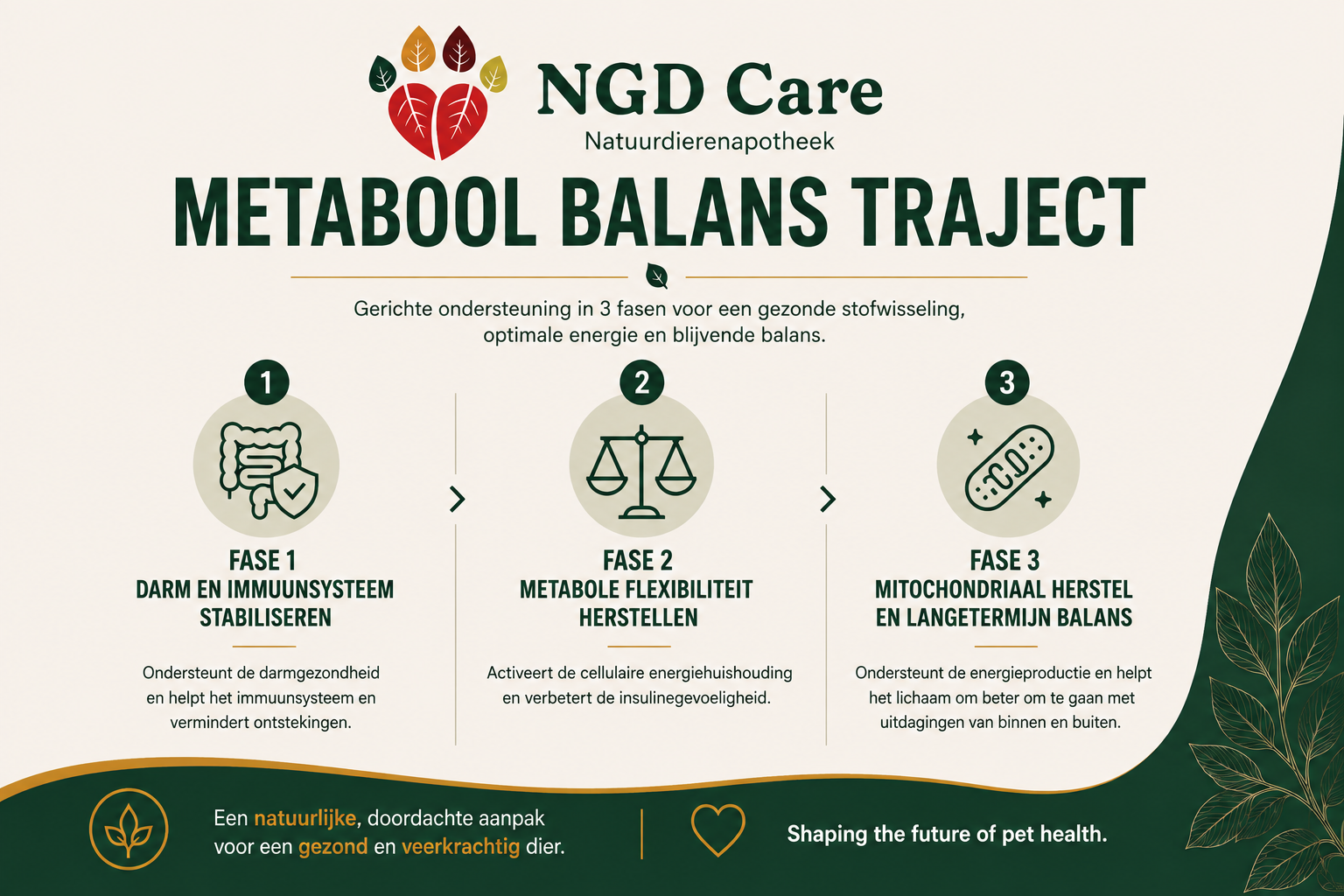
Dogs and cats with diabetes, insulin resistance, or persistent obesity often respond inadequately to diet foods and insulin alone, as chronic inflammation and mitochondrial exhaustion continue to undermine insulin sensitivity. The NGD Care Metabolic Support Pathway works in three phases: stabilizing the gut and immune system, improving insulin sensitivity via AMPK activation, and restoring the mitochondria that drive energy management.
Suitable for: diabetes mellitus, insulin resistance, obesity with reduced metabolic flexibility, fatty liver disease and chronic fatigue with no apparent cause. Always in combination with your vet’s treatment.
- Three phases that build on each other: gut stabilization, metabolic flexibility, and mitochondrial repair
- Para Reset (berberine and NAC) activates AMPK for insulin sensitivity, independent of insulin
- Supports both diabetes and insulin resistance, with or without obesity
- Longevity Support and CoQ10 restore energy production in depleted mitochondria
- Always in combination with dietary advice and in consultation with the attending veterinarian
Description
Your animal has received diabetes, insulin resistance or a metabolic diagnosis. Or you recognize the signs without a formal diagnosis. The NGD Care Metabolic Balance Trajectory has been developed as an addition to your veterinarian’s treatment. We explain what is really going on in your animal’s body, what the regular approach lacks and what we recommend in addition to veterinary care.
What your vet told you, and what else is going on
With diabetes, you will be given insulin to take home and the advice to switch to a special diet food. If you are overweight, you will be recommended a calorie-restricted diet. That is the standard approach, and insulin is indeed necessary for diabetes. But in an average consultation, there is no room to explain why metabolic dysregulation is so much more than a glucose problem, and why your animal’s body can function suboptimally for years even without diabetes.
What your vet may not have explained
Nutrition for metabolic dysregulation: why we recommend it differently
The standard recommendation for diabetes and obesity is carbohydrate-restricted diet food, often in kibble format. From the perspective of integrative medicine, Stefan Veenstra DVM has a fundamentally different point of view on this.
Our nutritional advice for metabolic dysregulation deliberately deviates from the standard guideline
And exercise?
Regular gentle movement increases insulin sensitivity via GLUT4 upregulation in muscle tissue, independent of insulin. This is one of the few interventions that works even if insulin signaling is disrupted. Avoid intensive exercise in case of unstable diabetes because of hypoglycemia risk. If you are overweight: gradual build-up to protect joints.
Three mechanisms driving metabolic dysregulation
Chronic inflammation blocks insulin receptors. Glucose remains in the bloodstream while cells signal energy deficiency. Insulin is present but does not reach its target.
Chronic metabolic load damages the energy factories of cells. Fatigue, muscle loss and reduced load capacity are the result.
The gut microbiome produces short-chain fatty acids that improve insulin sensitivity. In dysbiosis , this production decreases and the inflammatory load that maintains insulin resistance increases.
Our advice: phased support in addition to the care of your veterinarian
Insulin regulates glucose. This process supports how the body deals with it. The phasing is mechanistically determined: first stabilize the inflammatory pressure and intestinal barrier, then actively support metabolic flexibility, then consolidate the mitochondria and insulin sensitivity in the long term.
Phase 1 below (Prebiotics, Biofilm Balance, Vitamin C, Curcumin, Myco Immune Complex) gives most animals sufficient intestinal support in addition to this trajectory. 70% of insulin sensitivity is determined by the gut microbiome: if there is long-term dysbiosis, chronic intestinal complaints or medication use that puts a strain on the gut, the NGD Care Gut Recovery Trajectory goes deeper: it structurally tackles the gut barrier and the microbiome and thus forms a firmer foundation on which phases 2 and 3 of this trajectory more effectively engage.
Chronic low-grade inflammation blocks insulin receptors via serine phosphorylation of IRS-1 and maintains insulin resistance. LPS from a disturbed intestinal barrier activates TLR4 and NF-kB, which directly feeds this inflammatory cycle. Phase 1 lowers the inflammatory pressure and restores the intestinal barrier so that phase 2 can be optimally effective. Myco Immune Complex modulates macrophage balance towards an anti-inflammatory phenotype that reduces insulin resistance.
Para Reset combines berberine and NAC in one formulation. Berberine activates AMPK, the cellular energy sensor that regulates glucose uptake and fat oxidation independently of insulin. This is the key mechanism: berberine improves insulin sensitivity through a pathway that works even when insulin signaling is disrupted. NAC in the same formula increases glutathione, protects the liver from oxidative metabolic damage, and supports mitochondrial function as a cofactor. Omega-3 improves cell membrane fluidity and insulin receptor sensitivity. Note: Do not use Para Reset in case of unstable diabetes without veterinary supervision.
Longevity Support restores sirtuin activity that regulates mitochondrial biogenesis and glucose metabolism through NAD⁺. Resveratrol activates SIRT1 with direct improvement in insulin sensitivity. Relax Support provides magnesium bisglycinate as a cofactor for insulin receptor activation and glucose transport. Magnesium deficiency is associated with insulin resistance and in metabolic dysregulation, magnesium status is structurally reduced due to increased renal excretion.
What can you expect and when?
Metabolic dysregulation develops over years. Recovery requires the same patience. In case of diabetes: always manage the blood sugar curves and insulin needs together with your veterinarian. In insulin resistance without diabetes: pay attention to energy level, weight and muscle mass as indicators.
Intestine stabilized. Ignition pressure drops. More energy and better stool visible.
Para Reset active. Better glucose utilization via AMPK activation. In case of diabetes, possibly reduced insulin needs, always adjust in consultation with your veterinarian.
Mitochondrial repair. Better load capacity, muscle retention, more stable blood sugar.
Metabolic flexibility restored. Stable weight, better condition, reduced ignition sensitivity.
In case of diabetes: never adjust the insulin dosage independently based on this trajectory. Check blood sugar curves regularly with your veterinarian and inform them about supplementation. Berberine has an AMPK-activating effect that can affect insulin needs.
In addition to specific complaints
In metabolic dysregulation, the liver is often affected. NAC and liposomal glutathione actively protect liver tissue. Liposomal curcumin inhibits hepatic lipid accumulation via AMPK.
Muscle growth loss in metabolic dysregulation is an active problem. Longevity Support stimulates mitochondrial biogenesis in muscle cells. Omega-3 supports muscle maintenance via anti-inflammatory signaling.
Chronic stress increases cortisol, which induces insulin resistance via gluconeogenesis. A predictable daily structure and low-stress environment are therapeutically relevant in metabolic dysregulation. Adaptogen Complex supports HPA axis regulation.
Excess weight increases the mechanical load on joints and increases joint inflammation via adipokins. PEA Complex (PEA and Boswellia) addresses both components: mechanical pain and metabolic inflammation.
Not sure what is most relevant to your pet? Schedule a consultation. We tailor the support to the specific diagnosis, the stage of metabolic dysregulation and the co-medication of your animal.
Frequently Asked Questions (FAQ)
Can this pathway be used instead of insulin for diabetes?
No. The Metabolic Balance Trajectory is an addition to your veterinarian’s treatment, not a replacement. Insulin remains necessary for diabetes; Never adjust the dosage independently based on this trajectory and check blood sugar curves regularly with your veterinarian.
Is Para Reset safe to combine with insulin or other diabetes medications?
Berberine has an AMPK-activating effect that can affect insulin needs. Do not use Para Reset for unstable diabetes without veterinary supervision and always inform your veterinarian about the supplementation so that the insulin dosage can be adjusted if necessary.
How long does it take to see results?
The first effects, such as more energy and a calmer gut, are often noticeable from weeks 1 to 6. Better glucose utilization via AMPK activation typically follows at weeks 6 to 14, and mitochondrial recovery with more stable blood sugar at weeks 14 to 22.
Is this program also suitable without a diabetes diagnosis, for example in the case of obesity or insulin resistance?
Yes. Metabolic dysregulation begins years before blood sugar is elevated. This pathway is also suitable for insulin resistance without diabetes, obesity with reduced metabolic flexibility, fatty liver disease or chronic fatigue without a clear cause.
For which situations do we recommend this process?
Want to read the full scientific background?
Stefan Veenstra DVM explains how insulin resistance, AMPK, the gut-metabolic axis and mitochondrial exhaustion are related.
All supplements in this program
Developed and clinically substantiated by Stefan Veenstra DVM, integrative veterinarian at Natural Healthy Animals and founder of NGD Care. For personal guidance: NGD Care consultation →
This program is educational in nature and does not replace a veterinary consultation. The Metabolic Balance Trajectory is intended as a supplement to regular veterinary treatment, never as a replacement. In case of diabetes: never adjust insulin dosage independently. Always use in consultation with your veterinarian.
Ingredients, dosage and use
- See the individual ingredients
- For the first month, we recommend a double therapeutic dose of 2x daily. Then a maintenance dose of 1x daily.
- Each phase is suitable for a treatment of 2-4 months for a dog or cat <10kg and for 1-2 months for a dog of 10-30kg.
Disclaimer
- This product is a dietary supplement and not a substitute for a healthy lifestyle and varied balanced diet.
- The products are not medicines and cannot be used as medicines, but as a dietary supplement. In case of illness or other medical condition, always consult a veterinarian before use.
- Dietary supplements may have interactions and side effects with regular medications.
- Keep out of reach of young children.
- Consult an expert before using supplements in case of pregnancy, lactation, medication use and illness.