

Kidney Support Trajectory
€ 0,00
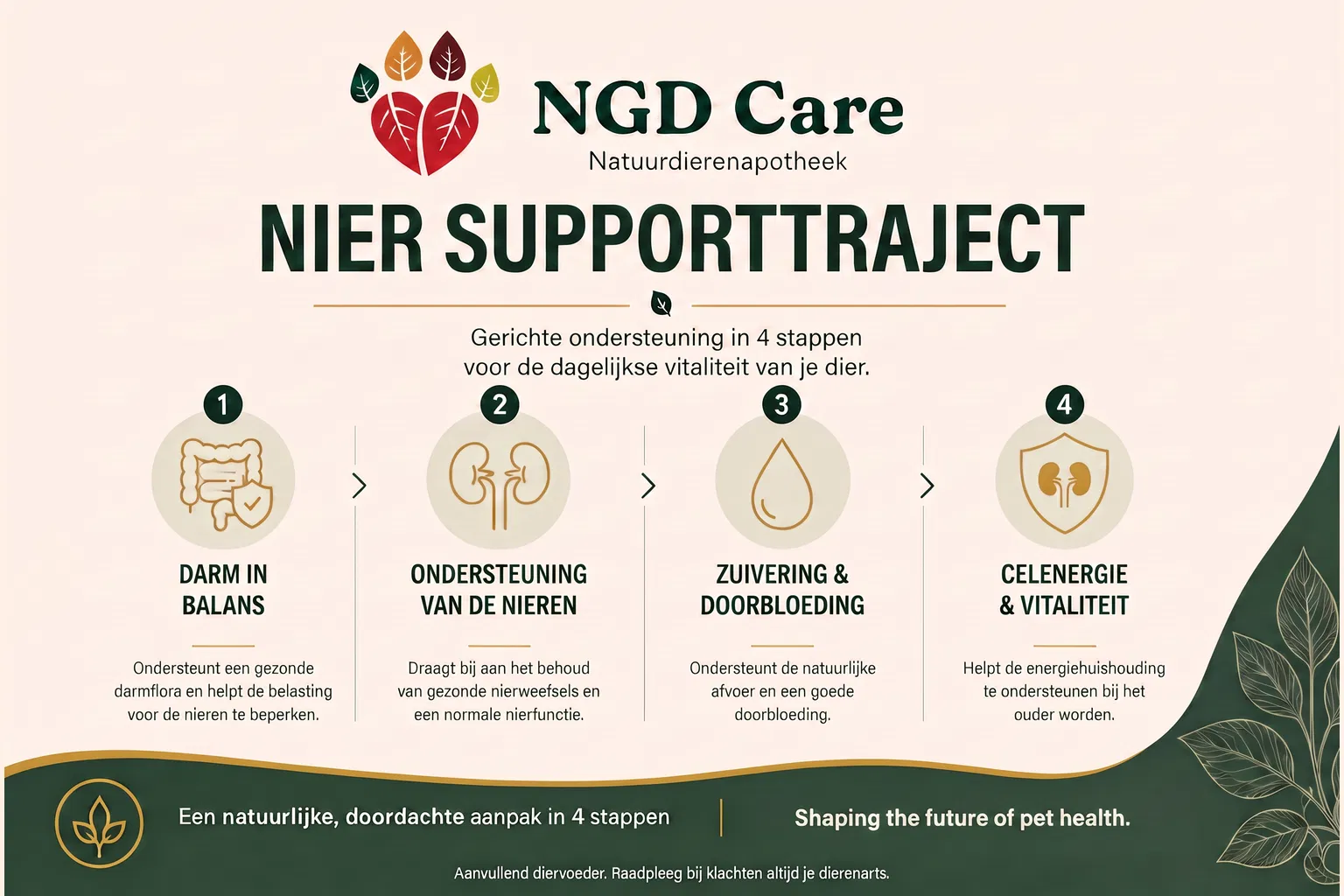
Additional support for chronic kidney strain, elevated kidney values and CKD in dogs and cats. Based on the gut-kidney axis, anti-fibrosis and mitochondrial repair. Always complementary to veterinary care.
- Four phases: stabilizing the intestine, inhibiting fibrosis, repairing mitochondria, long-term maintenance
- Gut-kidney-axis approach: reducing uremic toxin load via microbiome repair
- Omega-3 with Direct Veterinary Evidence in Cats With CKD
- Additional symptom support for appetite, urea and fatigue
Description
Your animal has been diagnosed with kidney failure. This bundle has been developed as a supplement to your vet’s treatment. We explain what happens in your animal’s body, what your vet probably hasn’t told you yet, and what we recommend in addition to regular care.
What your vet told you, and what else is going on
Your vet has shown blood values, perhaps recommended a kidney scale diet, and may have prescribed medication. That is right and necessary. But in an average ten-minute consultation, there is no room to explain why kidney disease is progressive, what mechanisms drive the decline, and what else is possible besides diet and medication.
Here’s what really happens in your animal’s body, and why early supplemental support can make all the difference.
What your vet may not have explained
Nutrition for kidney disease: why we recommend it differently from the regular guideline
Chances are, your vet has recommended a kidney diet. Low in protein, low in phosphorus, often in the form of canned food or a specialized kibble. This is the standard guideline, but from an integrative medicine perspective, Stefan Veenstra DVM has a fundamentally different point of view on this, substantiated by what actually happens in the body of an animal with kidney disease.
Our nutritional advice for kidney disease deliberately deviates from the standard guideline
And what about phosphorus?
Hyperphosphatemia is a real problem in advanced CKD and requires attention. But the solution is not to give poor quality food with little phosphorus. The solution is to provide high-quality nutrition with targeted phosphorus adsorption if phosphorus levels require it. Phosphoraadsorbents are given with meals and bind phosphorus in the intestine for absorption, independent of food quality. Discuss this with Stefan Veenstra DVM in a personal consultation for the right approach for your animal.
Three mechanisms that drive kidney disease
To understand why we have put together this bundle in this way, it is important to know which three processes determine the progression of kidney disease. The collection focuses on each of these three.
Gut bacteria produce indoxyl sulfate that reaches the kidneys, activates TGF-β1 and accelerates fibrosis. This starts in the intestine, not in the kidney.
TGF-β1 converts kidney cells into scar tissue. This is irreversible. Inhibition of TGF-β1 in early stages is the main purpose of the beam.
The kidneys consume an enormous amount of energy. In CKD, the energy factories in kidney cells are depleted, which accelerates progression.
Our advice: phased support in addition to the care of your veterinarian
The order of the phases is not random. As long as the gut continues to supply toxins that accelerate fibrosis, an anti-fibrotic supplement has less effect. Phase 1 lowers the toxin supply so that phase 2 can work optimally.
We don’t start with the kidney but with the intestine. Gut bacteria produce indoxyl sulfate, a toxin that reaches the kidneys through the blood, causing oxidative damage and accelerating fibrosis. Prebiotics shift the microbiome towards bacteria that produce less of this toxin. Liposomal curcumin simultaneously inhibits TGF-β1 signaling that drives fibrosis. Liposomal lactoferrin binds LPS from the intestine directly and thus reduces the inflammatory load on the kidneys.
Longevity Support is our core formula for kidney disease. It combines astragaloside IV, which has been proven to inhibit TGF-β1 and protect the podocytes that form the filtration barrier, with NAD⁺ for mitochondrial biogenesis in renal cells, resveratrol for SIRT1 activation, and ergothioneine for mitochondrial membrane protection. Cycloastragenol in the formula is one of the few natural telomerase activators, which supports the long-term recovery capacity of tubule cells. Myco Immune Complex modulates the immune response in kidney tissue. Omega-3 protects the tiny blood vessels that oxygenate the kidney cells, with direct veterinary evidence in cats with CKD.
CoQ10 is essential for energy production in the renal tubule cells that do the most of the work. In kidney disease, CoQ10 is depleted. Liposomal glutathione restores the intracellular antioxidative capacity lost due to chronic toxin exposure. Both supplements are given in liposomal form for maximum absorption, even if the intestinal barrier is compromised.
CKD does not stop after a protocol. The mechanisms that drive progression remain active. We recommend continuing the core of the bundle as a long-term maintenance strategy, tailored to the kidney values that your veterinarian checks every three months.
What can you expect and when?
Kidney disease develops over years. Support works on the same timescale. Always focus on the kidney values that your vet checks every three months, not on immediate clinical improvement in the first weeks.
Intestine stabilized. Reduced systemic toxin load. Your animal may be a little more alert and the stool improves.
Fibrosis process slowed down. Possible improvement of proteinuria at subsequent check-up. More vitality visible.
Oxidative protection active. Kidney values stabilize at next check-up. Better appetite and fitness.
Maintenance phase. Progression inhibited. Maintaining quality of life in addition to veterinary treatment.
Check kidney values every 3 months with the treating veterinarian. In case of CKD stage 3-4 or co-medication, always schedule a personal consultation for tailor-made advice.
In addition to specific complaints
In addition to the bundle, we recommend additional support based on the complaints your animal has. Not every animal has everything, but these are the most common complaints of kidney disease and what we use for it.
Uremia causes nausea through the central nervous system. CBD oil has an antiemetic effect and stimulates appetite through the endocannabinoid system, without sedation.
Chlorella in Green Detox binds urea precursors in the intestine for absorption. Gut Barrier Support reduces the bacterial production of nitrogen-containing waste products via fulvic acid.
In kidney disease, B vitamins are excreted at an accelerated rate. Deficiency of B12 and folate worsens anemia and fatigue. Liposomal vitamin B complex optimally replenishes these deficiencies.
Chronically ill animals are often more restless and sensitive to stimuli. PEA and boswellia supports comfort and reduces neuroinflammation. Ashwagandha and rhodiola support stress and restlessness.
Not sure what is most relevant to your pet? Schedule a consultation. We tailor the additional support to the specific complaints, kidney stage and co-medication of your animal.
For which situations do we recommend this bundle?
Want to read the full scientific background?
Stefan Veenstra DVM explains how the gut-kidney axis, TGF-β1 fibrosis, diagnostics and mechanistically substantiated phasing are related.
All supplements in this bundle
Developed and clinically substantiated by Stefan Veenstra DVM, integrative veterinarian and founder of NGD Care and Naturally Healthy Animals. For personal guidance: NGD Care consultation →
This bundle is educational in nature and does not replace a veterinary consultation. The Kidney Support Bundle is intended as a supplement to regular veterinary treatment, never as a replacement. Always use in consultation with your veterinarian. In case of CKD stage 3-4 or co-medication, we recommend a personal consultation.
Ingredients, dosage and use
- See the individual ingredients
- For the first month, we recommend a double therapeutic dose of 2x daily. Then a maintenance dose of 1x daily.
- Each phase is suitable for a treatment of 2-4 months for a dog or cat <10kg and for 1-2 months for a dog of 10-30kg.
Disclaimer
- This product is a dietary supplement and not a substitute for a healthy lifestyle and varied balanced diet.
- The products are not medicines and cannot be used as medicines, but as a dietary supplement. In case of illness or other medical condition, always consult a veterinarian before use.
- Dietary supplements may have interactions and side effects with regular medications.
- Keep out of reach of young children.
- Consult an expert before using supplements in case of pregnancy, lactation, medication use and illness.